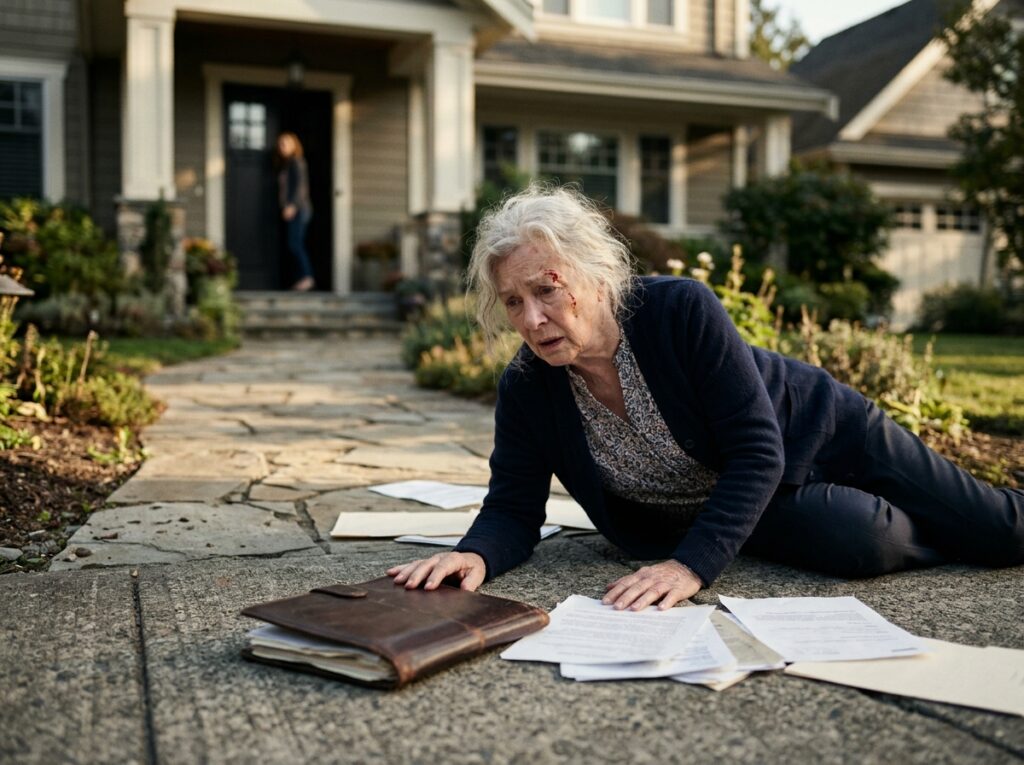
I never thought there would come a day when my own daughter would pull me by the hair and toss me out as if I were garbage
On a quiet Sunday afternoon, I drove across town with a slim folder resting on the passenger seat, believing I was still her mother, still allowed to be there. The documents were simple: old medical bills, a notarized statement, and a letter my late husband had asked me to deliver by hand if the family ever began fighting over things that were never supposed to matter more than love. I parked carefully in front of Emily’s house, straightened my sweater, wiped my palms against my skirt, and reminded myself that families had survived things worse than silence.
For almost a year, Emily had barely spoken to me. Her messages had become shorter, colder, almost like they had been written by someone standing beside her, telling her which words to choose. When my husband, Thomas, was still alive, he used to say, “Give her time. She’s proud, but she has your heart underneath it.” I wanted to believe that. Even after his funeral, even after she stopped coming by, even after her husband, Mark, began answering her phone and saying she was too busy to talk, I told myself that one day my daughter would open the door, see me standing there, and remember who I was.
That day, the door opened to Emily’s face, tense and almost unrecognizable. Her eyes darted to the folder in my hand before they even settled on me. She looked thinner, sharper, guarded in a way that made my chest ache.
“What do you want?” she asked, already shifting aside as though even the house didn’t want me inside.
“I came to bring some papers,” I said quietly. “It won’t take long.”
She didn’t invite me in with warmth. She didn’t smile. She simply moved back just enough for me to step across the threshold, and for a foolish second, I thought that small space meant hope. Inside, the living room looked perfect, almost staged. There were pale cushions lined neatly on the sofa, fresh flowers on the table, framed photos arranged on the shelves, but none of them showed me. Not one. Not from her childhood, not from her wedding, not from the holidays when I used to cook for three days just to see her happy for one evening.
Her husband, Mark, stood beside the kitchen island, his jaw tight. He didn’t say hello. He stared at me like I had broken into his home. When I tried to explain how Thomas had asked me to deliver the documents in person, Mark crossed the room in two quick steps.
“Get out,” he said.
“I’m her mother,” I replied, though the words sounded weak even to my own ears.
Emily looked away. That hurt more than anything Mark could have said. I held the folder out toward her and tried to keep my hand steady. “Please, Emily. Your father wanted you to have this before anything was decided.”
Mark’s eyes narrowed. “Before what was decided?”
I didn’t understand his anger at first. I thought perhaps he was grieving too, in his own hard, ugly way. But then Emily’s face changed. A flash of panic moved across it so quickly I almost missed it.
“Mom,” she said under her breath, “you shouldn’t have come here.”
“I didn’t come to fight,” I told her. “I came because your father trusted me with this.”
Mark moved closer, too close, and reached for the folder. I pulled it back, not because I wanted to keep it from them, but because something in his expression frightened me. His hand struck the papers, not me, but the force of it startled me enough that I stumbled. My foot caught against the edge of the entry rug. The folder slipped from my hands. Papers spilled across the polished floor and scattered toward the doorway.
May you like
I heard my daughter-in-law call sweetly, “Rest, Mom, I’ll handle everything,” whenever my son was home. But the moment he left, her mask slipped. That evening, as I knelt mopping the floor, she sneered, “You useless old woman!”.
I built a billion-dollar empire just to see my mother smile. I came home early from a merger to find her kneeling on the marble floor, scrubbing it with a toothbrush while my wife poured red wine over her head. “Missed a spot, you old peasant!” my wife screamed. My mom just sobbed, “Please, my back…” My wife laughed, “If you tell my husband, I’ll put you in a cage.” She didn’t see me in the doorway. I didn’t say a word. But the revenge I unleashed over the next 24 hours would make her beg for the very mercy she had just denied the woman who gave me life.
I was seventy-eight years old when my son’s fiancée looked me in the eye and said, “Get on your knees and wash my feet.” In my own home, on my own floor, I felt my dignity cracking with every second. I thought the humiliation couldn’t get worse—until the doorbell rang, the front door opened, and a voice behind her said, “What the hell is going on?”.
For a moment, nobody moved.
Then Mark stepped forward again, his voice low and hard. “You need to leave now.”
I bent down to gather the documents, but Emily grabbed my arm. Not gently. Not like a daughter helping her mother. Like someone desperate to remove evidence before it could breathe. She pulled me toward the door, whispering through clenched teeth.
“Get out,” she said. “It’s three million. You’re not getting one cent.”
“I’m not asking for money,” I tried to say, but my words broke apart. “Emily, I never came for that.”
She pushed the door open, still gripping my sleeve, and in the confusion, I lost my balance on the front step. I fell hard onto the walkway. My cheek scraped the concrete, and for several seconds I could not move. The door closed behind me with a final, terrible sound. My hands landed near the scattered pages that had followed me outside, and my eyes filled before I could stop them. Not because of the pain. Because the house I had once helped paint, the house where I had brought soup when Emily was sick, the house where I had held my granddaughter before visits suddenly stopped, now stood silent behind me like I had never belonged there at all.
They believed fear would make me stay quiet. They never noticed the woman across the street calling 911, her hands trembling. And they had no idea what the police were about to discover once they asked the one question no parent ever expects to hear, because the folder Mark had tried to kick aside wasn’t only a stack of papers. It was evidence.
(I know you’re curious about the next part, so please be patient and read on in the comments below. Thank you for your understanding of the inconvenience. please leave a ‘YES’ comment below and give us a “Like ” to get full story )
I still remember the exact sound my head made when it struck the concrete, a dull, empty crack that didn’t feel like it could have come from me. For one brief moment, everything became silent, as if the whole world had stepped back to see what would happen next.
Then the pain arrived.
It moved through me slowly, blooming from my cheek into my skull, down the side of my neck, and deep into my chest. I tasted metal. My fingers shook against the driveway as I tried to lift myself, but my arms refused to obey. Not yet. Not after what had just happened.
Across the street, the woman who always watered her roses at exactly four in the afternoon stood completely still, the hose still running in her hand. Her eyes stayed fixed on me. On the scrape on my cheek. On the papers spread across the driveway. On the door that had just been shut in my face.
Through the ringing in my ears, I heard her voice faintly.
“Hello? Yes, please hurry. There’s been an incident.”
Inside the house, there was no movement. No apology. No pause. No sign that the daughter I had raised was still in there somewhere.
Only silence.
By the time the police arrived, I was sitting upright, though I couldn’t remember how I had managed to get there. The folder was lying a few feet away, its papers scattered across the ground like fallen leaves. One of the officers crouched beside me.
“Ma’am, can you tell me what happened?”
I opened my mouth, but at first, no words came out. My voice felt buried beneath years of things I had never allowed myself to say.
“My daughter,” I finally whispered. “And her husband.”
The officer’s expression changed, not dramatically, not in a way that made the neighbors gasp, but enough for me to know he understood that this was not just a simple family disagreement. His partner collected the papers carefully, sliding each sheet back into the folder without reading too much in the open air. The woman from across the street, Mrs. Patterson, came over with a blanket and knelt beside me, her face pale with worry.
“I saw enough,” she told the officer. “She came with papers. They forced her out. She fell. They didn’t come back to help her.”
I wanted to tell her not to make trouble. That was my habit, my curse, the thing I had been trained by love and disappointment to do. Smooth it over. Keep the family name clean. Don’t embarrass anyone. Don’t make Emily angry. Don’t give Mark another reason to say I was unstable, dramatic, interfering.
But I looked down at my hands, old hands, shaking over papers my husband had trusted me to protect, and something in me stopped bending.
The officer asked if I needed medical attention. I said yes, though the word felt strange. For years, I had said no to every kind of help. No, I was fine when Thomas got sick and I lifted him from the chair alone. No, I was fine when Emily missed my birthday. No, I was fine when my savings started disappearing into bills I didn’t understand because Mark said everything had to be “handled quickly.” No, I was fine when my own daughter stopped calling me Mom and started calling me by my first name whenever her husband was in the room.
But that afternoon, on the sidewalk outside the house where my daughter had chosen silence over me, I finally said yes.
An ambulance arrived, though I insisted I could still walk. The paramedic cleaned the scrape on my cheek and asked me questions I answered slowly. My name. My age. Whether I had lost consciousness. Whether this had happened before. That last question made me turn away.
Had it happened before?
Not like this. Not where neighbors could see. Not with concrete under my palms and police lights flashing behind me. But there are many ways to be pushed out of someone’s life. There are many ways to be made to feel small without anyone raising a hand.
It had started after Thomas died.
At first, Emily cried in my arms like she was a little girl again. She slept in my guest room for two nights, wrapped in his old cardigan, saying she didn’t know how to live in a world without her father. I held her hair back from her face and whispered that I didn’t know either. We were both broken then, but we were broken together.
Then Mark began visiting more often.
He came with folders, bank statements, legal words, and a voice that always sounded calm in a way that made disagreement feel foolish. He told Emily grief made people confused. He told me I shouldn’t worry about numbers. He told us Thomas would have wanted everything to be “efficient.” I remember that word because he used it like a key to every locked door.
Efficient meant selling Thomas’s old truck before I was ready.
Efficient meant closing a joint account I didn’t realize Mark had no right to touch.
Efficient meant Emily signing papers she barely read while he stood behind her with one hand on her shoulder.
Efficient meant me being left out of conversations about my own husband’s estate because, as Mark once said, “This is really between the next generation now.”
The next generation.
As if thirty-eight years of marriage could be erased by a phrase.
For months, I believed Emily was simply overwhelmed. When she stopped inviting me over, I told myself she needed space. When she didn’t answer my calls, I told myself she was tired. When she accused me of hiding money from her, I told myself grief had twisted her thoughts. But Thomas had known something was wrong before he died. That was why he had left the folder with our attorney and written my name across it in his slanted handwriting.
Give this to Emily only if Mark begins controlling the estate.
I had read that line a hundred times before I found the courage to drive across town.
At the hospital, the police officer returned with the folder in a sealed evidence bag. He asked whether I understood what was inside. I nodded. Some of it, yes. Not all of it. Thomas had always been better with documents. I knew there were medical bills showing what he had paid for Emily years ago when she had nearly lost her home after a business failure. I knew there was a notarized statement explaining that the three million dollars Mark kept mentioning had not been left to Emily outright. It had been placed in a trust, with conditions, because Thomas had feared exactly what was happening.
But there was another page I had never fully understood until the officer pointed to it.
“Ma’am,” he said gently, “do you know why your husband requested an independent review of these account transfers?”
My heart tightened. “He said something didn’t feel right.”
The officer looked at me for a long moment, then closed the folder. “We’ll need to speak with the attorney.”
That was when I realized the truth I had carried into Emily’s house was heavier than grief. It was not just proof that I had come for peace. It was proof that someone had been moving money, shaping lies, and turning my daughter against me before I ever reached her doorstep.
I spent that night in a small hospital room with a bandage on my cheek and Mrs. Patterson sitting in the chair beside me because she refused to leave until my sister arrived. Emily did not call. Mark did not call. I stared at my phone until the screen blurred, waiting for a message that never came.
At midnight, I finally stopped waiting.
The next morning, I called the attorney, Mr. Lowell, a careful man with silver glasses and a voice that always seemed to measure each word before releasing it. When I told him what had happened, he went quiet for so long I thought the call had dropped.
“Do not speak with Mark alone,” he said at last.
“I don’t want to speak with Mark at all.”
“And Emily?”
Her name opened something soft and wounded inside me. “I don’t know.”
Mr. Lowell sighed. “Your husband was afraid Mark had persuaded Emily that you were withholding assets. Thomas believed Mark was pressuring her to challenge the trust. He also suspected Mark had obtained access to documents he should not have had.”
“Why didn’t Thomas tell me everything?”
“Because he was trying to protect both you and Emily. He hoped he was wrong.”
That was Thomas. Always leaving room for people to become better than their worst moment. Even Mark. Even at the end.
Two days later, I sat in Mr. Lowell’s office under a framed painting of a harbor, my hands folded around a paper cup of tea I couldn’t drink. He spread the documents on the table and explained the truth piece by piece.
The three million dollars was real, but it was not a prize, not a pile of cash for Emily or Mark to grab. It was the remaining value of Thomas’s investments, life insurance, and a property sale from years before. Thomas had placed most of it in a protected family trust. A portion was intended for my care. A portion was reserved for Emily, but only under conditions that prevented anyone else from controlling it. Another portion was set aside for our granddaughter, Lily, whom I had not seen in months.
My breath caught at her name. “Lily is included?”
Mr. Lowell nodded. “Your husband wanted her education secured no matter what happened between the adults.”
I pressed my fingers to my lips. Lily was seven years old. She had Thomas’s eyes and Emily’s stubborn little chin. The last time I had seen her, she had asked why Grandma didn’t come over anymore. Emily had smiled too quickly and said, “Grandma is busy.” I had gone home and cried into a dish towel because correcting her would have meant starting a fight in front of a child.
“There’s more,” Mr. Lowell said.
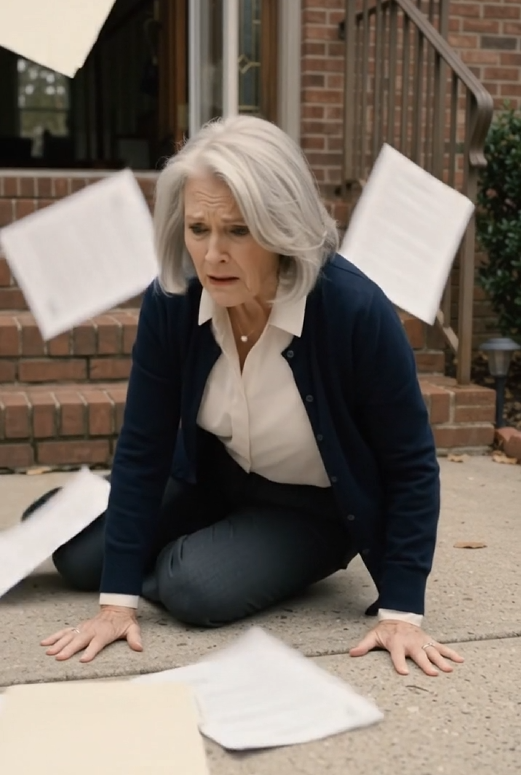
Of course there was. In stories like ours, the truth never arrives as one clean sentence. It comes in layers, each one heavier than the last.
Thomas had discovered that someone had attempted to file a change of beneficiary using outdated information and a questionable signature. The change had never been completed, but the attempt had triggered a review. He had also noticed withdrawals from an account connected to Emily’s household expenses, withdrawals she claimed not to understand. He had written down dates, amounts, names, and concerns. He had not accused Mark directly, but every line pointed toward the same shadow.
I felt sick, not because of the money, but because I suddenly saw my daughter in a different light. Not cruel first. Afraid first. Cornered first. Convinced first. What she had done to me was wrong. Nothing could erase that. But I began to wonder how long Mark had been feeding her a version of me that made betrayal feel like defense.
That afternoon, Emily finally called.
I watched her name flash across my phone until it almost stopped. Mr. Lowell advised me to let it go to voicemail, but I answered because mothers are foolish in ways no court can fix.
For three seconds, neither of us spoke.
Then she said, “Mom?”
Not my first name. Not that cold, distant tone. Mom.
I closed my eyes. “Emily.”
Her breathing shook. “Mark said the police came back. He said you’re trying to ruin us.”
“I told the truth.”
“You brought documents to my house like you wanted to start something.”
“I brought documents your father asked me to give you.”
“He said you were hiding the trust. He said Dad meant to leave it to me, but you changed things after he got sick.”
The room tilted. “Emily, your father created that trust himself. Before he got too sick. Mr. Lowell has every record.”
Silence.
Then, smaller: “That’s not what Mark said.”
“I know.”
“He said you never liked him.”
“I didn’t trust him. That is not the same thing.”
Her voice cracked. “Why didn’t you tell me?”
“I tried. Every time I called, he answered. Every time I came by, you were unavailable. Every time I asked to see Lily, something came up.”
Emily began crying, but quietly, as if someone might hear. “I thought you were punishing me.”
“No,” I said, and the word carried every sleepless night I had survived. “I was waiting for you.”
She did not apologize then. Not fully. Pain rarely becomes honesty in one phone call. She only said she needed time. I said I did too. When we hung up, I held the phone against my chest and cried not because everything was fixed, but because a locked door had opened one inch.
The investigation moved slowly, the way real life always does, no matter how desperate the heart becomes. There were interviews, statements, bank records, meetings with attorneys. Mark became polite in public and furious in private, according to what Emily later admitted. He told her I was manipulating everyone. He told her the trust would leave her with nothing. He told her Lily’s future would disappear unless she stood with him.
But lies have one weakness. They need darkness. Once everyone begins turning on the lights, they start looking smaller.
Mrs. Patterson’s security camera had captured enough of the front yard to show that I had not arrived aggressively, had not threatened anyone, had not done the things Mark claimed. The hospital report supported my account of the fall. The attorney produced Thomas’s original documents. The bank flagged the attempted changes. And when Emily finally agreed to meet Mr. Lowell without Mark present, the story he had built around her began to collapse.
She came to my apartment three weeks after that Sunday.
I saw her through the peephole and almost didn’t open the door. That is the truth. Love does not erase fear instantly. I stood there with my hand on the lock, remembering the look in her eyes when she told me I wouldn’t get a cent, remembering the cold door, the concrete, the silence after I fell.
Then I opened it.
Emily stood in the hallway wearing no makeup, her hair pulled back messily, her face pale and tired. Lily stood beside her, clutching a stuffed rabbit. The moment my granddaughter saw me, she broke away and wrapped her arms around my waist.
“Grandma,” she whispered.
That one word nearly took me to my knees.
Emily watched us with tears running down her face. “I’m sorry,” she said. “I know that isn’t enough. I know it doesn’t fix it. But I’m sorry.”
I wanted to say something wise. Something strong. Instead, I touched Lily’s hair and said, “Come inside.”
We sat at my small kitchen table, the same table where Emily had done homework as a child, the same table Thomas had sanded and painted because we couldn’t afford a new one. Lily ate toast with jam while Emily told me what had been happening behind the perfect walls of her perfect house.
Mark had controlled the mail. Mark had handled the calls. Mark had told her which relatives were “against them.” He had convinced her that Thomas’s trust was an insult, that I had manipulated a dying man, that if she didn’t act quickly, everything would be stolen from her. And Emily, grieving, exhausted, terrified of losing her lifestyle and her marriage at the same time, had believed the person standing closest to her.
“I hated you because it was easier than admitting I was scared,” she said.
Her honesty hurt, but it was clean. Cleaner than silence. Cleaner than excuses.
“I can forgive fear,” I told her slowly. “But I cannot pretend what happened didn’t happen.”
She nodded. “I’m not asking you to.”
That was the first grown-up thing my daughter had said to me in a long time.
The legal process did not end with a dramatic scene in a courtroom. It ended in smaller, steadier ways. Protective orders. Financial reviews. Mark leaving the house after Emily finally chose to cooperate. A formal separation. A trust administrator appointed so no one could twist Thomas’s wishes again. Lily’s education fund secured. My care protected. Emily’s portion preserved, but placed beyond Mark’s reach.
When Mark realized the money could not be controlled through Emily, his charm disappeared. He sent messages full of blame, then apologies, then blame again. Emily read them with shaking hands and then, one by one, stopped answering. I watched her learn the hardest lesson I had ever learned myself: sometimes the person you defended most is the person you most needed protection from.
Months passed before Emily and I could sit together without the past sitting between us like a third person. Healing was not a straight road. Some days she brought Lily over and we laughed while making pancakes. Other days, I remembered her voice in my ear and had to step into another room to breathe. She never told me to get over it. She never asked why I still flinched when someone moved too quickly near a doorway. She simply waited, the way I had waited for her.
One autumn afternoon, we visited Thomas’s grave together. The trees above the cemetery had turned gold, and Lily placed a small drawing beside the stone. Emily stood with her arms wrapped around herself.
“I think Dad knew,” she said.
“He knew enough to be afraid,” I answered.
“He still protected me.”
“Yes.”
Her lips trembled. “Even after I became someone he wouldn’t recognize.”
I looked at my daughter then, really looked at her. Not as the woman who had shut the door on me. Not only as the child I had raised. But as a person standing in the wreckage of her own choices, trying to become someone better.
“Your father believed people could come back from their worst day,” I said.
Emily looked at me. “Do you?”
I thought of the concrete. The folder. The police lights. The months of silence. I thought of Lily asleep on my sofa with her rabbit tucked under her chin. I thought of Thomas’s handwriting on the folder, his final act of love not for money, but for truth.
“I believe people can come back,” I said. “But they have to walk the whole road.”
She nodded, crying quietly. “I’ll walk it.”
And she did.
Not perfectly. Nobody does. But she showed up. She called. She listened. She let the trust do what Thomas designed it to do instead of fighting it. She found work again, not because she needed to prove anything to me, but because she needed to prove to herself that she could stand without Mark’s voice in her ear. She took Lily to counseling. She went herself. She brought me groceries when my hip hurt, then laughed when I scolded her for buying the expensive oranges. Slowly, painfully, honestly, we became a family again, not the old one, because that one was gone, but a new one built with clearer eyes.
A year after that Sunday, Emily invited me back to the house.
For a long time, I sat in my car outside and stared at the front steps. The flowers were different. The door had been repainted. The curtains were open. Still, my hands tightened around the steering wheel.
Then the door opened, and Lily ran out first.
“Grandma, come see my room!”
Emily stood behind her, not rushing me, not pretending the moment was easy. She simply waited on the porch with tears in her eyes and the door open wide.
I stepped out slowly. Each step up the walkway felt like walking through a memory and changing its ending. When I reached the place where I had fallen, I stopped. Emily came down the steps and stood beside me.
“I’m so sorry,” she whispered again.
This time, I believed she understood what the words weighed.
“I know,” I said.
Inside, on the living room shelf, there was a framed photograph I had not seen before. It was Thomas holding baby Lily, Emily leaning against his shoulder, and me standing beside them with my hand on my daughter’s back. We all looked younger. Unaware. Safe in a way you only recognize after safety is gone.
“I found it in a box,” Emily said. “I should have put it up years ago.”
I touched the frame gently. “He loved this picture.”
Ảnh hiện tại
“He loved us,” she said.
“Yes,” I answered. “He did.”
That evening, we ate dinner at the same table where Mark used to stand like a guard over every conversation. He was gone now. Not erased from what happened, not magically forgiven, but gone from the center of our lives. The house felt different without his shadow. Smaller, maybe. Warmer.
After dinner, Lily asked me to tell her a story about her grandfather. I told her about the time Thomas tried to bake a birthday cake for Emily and used salt instead of sugar. Emily laughed so hard she covered her face, and for one bright second, I saw the girl she used to be. Not because the past had returned, but because something gentle had survived it.
Later, when I went home, Emily walked me to the car. She held the door open, then hesitated.
“Mom?”
I turned.
“I thought the truth was going to take everything from me,” she said. “But it gave me back the only things that were real.”
I looked at her, my daughter, my heartbreak, my unfinished prayer.
“That’s what truth does,” I said. “It takes what was never yours to keep, and it returns what should never have been stolen.”
She hugged me then. Carefully at first. Then tighter. I closed my eyes and let myself hold her back.
I had gone to her house carrying a folder. I thought it contained medical bills, legal papers, and my husband’s final instructions. But what I really carried was the last piece of our family’s truth. And truth, I learned, does not always arrive gently. Sometimes it scatters across a driveway. Sometimes it sits in a sealed bag under police lights. Sometimes it breaks a mother’s heart before it saves a daughter’s life.
But when it finally stands up, it does not shake.
It does not beg.
It opens the door, steps inside, and brings everyone who is willing back into the light.





