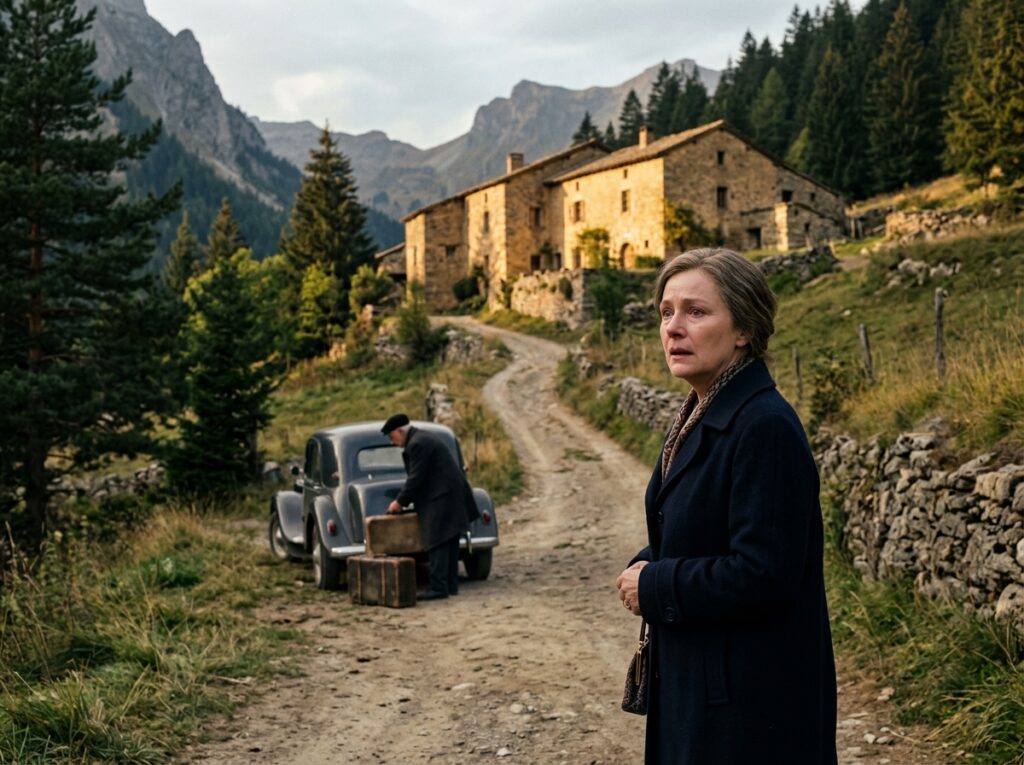
The driver stopped in front of a weathered stone house with pale blue shutters and a roof the color of old copper.
For several seconds, I did not move.
The house sat halfway up a grassy slope overlooking the valley, surrounded by apple trees, lavender, and a low stone wall softened by moss.
Golden evening light spilled across the mountains.
It should have felt peaceful.
Instead, my heart was pounding so hard that I could hear it.
“Who is Pierre?” I asked.
The driver looked at me in the rearview mirror.
His English was careful.
“You will see.”
That answer did not help.
He stepped out.
I followed.
The mountain air smelled of pine, wet earth, and something sweet blooming near the porch.
My suitcase wheels were useless on the gravel, so the driver carried it.
We had barely reached the front steps when the door opened.
An old man stood there.
Silver hair.
Lean frame.
Dark sweater.
One hand resting on a cane.
He looked to be in his late seventies.
Maybe eighty.
And the instant he saw me, his face collapsed.
Not dramatically.
Quietly.
Like a wall giving way from the inside.
“Eleanor.”
Nobody had said my name like that in forty years.
I stopped breathing.
The driver set down my suitcase.
Then stepped away.
The old man took one slow step forward.
I stared at him.
At the sharp nose.
The deep-set gray eyes.
The slight tilt of his head.
And suddenly I was twenty-two again.
Paris.
A summer language program.
Cheap wine.
Rain along the Seine.
A young French engineering student named Pierre Laurent who had once told me he would follow me anywhere.
I gripped the porch railing.
“No.”
Pierre’s eyes filled.
“Yes.”
I shook my head.
“No.”
“Eleanor.”
“You’re dead.”
He flinched.
“I know you believed that.”
My knees weakened.
Forty years earlier, before Richard.
Before marriage.
Before widowhood.
Before a modest apartment filled with homework and secondhand furniture and one little boy who grew into the man I buried last week.
There had been Pierre.
Not an affair.
Not a secret marriage.
A life that almost happened.
I had loved him.
And then, in the middle of that summer, I received a telegram saying Pierre had been killed in a climbing accident near Chamonix.
I returned to New York shattered.
Six months later, I met Richard’s father.
Three years after that, my son was born.
I had never gone back to France.
Never because I didn’t remember.
Because I remembered too well.
I stared at the man standing in front of me.
“You died.”
Pierre whispered:
“No.”
“Then why did they tell me you did?”
His jaw tightened.
“That is why Richard sent you here.”
My son’s name cut through everything.
I stepped toward him.
“You knew Richard?”
Pierre closed his eyes.
Then nodded.
“For twelve years.”
The valley seemed to tilt.
“What?”
“He came here first when he was twenty-six.”
I stared.
“That’s impossible.”
“No.”
“He never told me.”
“I know.”
My grief changed shape.
“Why?”
Pierre moved aside.
“Come inside.”
“No.”
My voice cracked.
“Tell me here.”
He looked at me for a long moment.
Then:
“Because your son believed someone had lied to you forty years ago.”
Silence.
“And he was right.”
I could not speak.
Pierre continued.
“He spent years trying to understand why.”
The wind moved through the apple trees.
I gripped the railing harder.
“Who?”
Pierre’s expression changed.
Not sadness.
Anger.
Old anger.
“Your father.”
I stepped back.
My father had been dead nineteen years.
Strict.
Controlled.
Successful.
The kind of man who believed love was acceptable only after it had passed an audit.
He had hated France.
Hated that I wanted to stay.
Hated Pierre before he’d ever met him.
But a fake death?
“No.”
Pierre nodded slowly.
“He came to see me.”
I stared.
“Who?”
“Your father.”
“When?”
“The morning after I asked you to marry me.”
My chest went cold.
Pierre continued.
“He offered me money.”
“For what?”
“To disappear.”
I almost laughed.
“My father didn’t know you had proposed.”
“He knew everything.”
That sounded like him.
“He told me if I stayed with you, he would make sure you lost your family, your money, your education, everything.”
“You should have told me.”
“I tried.”
His voice broke.
“I wrote.”
I stared at him.
“Letters?”
“Dozens.”
I shook my head.
“I never received them.”
“I know.”
He swallowed.
“Richard found them.”
My son.
Again.
“What do you mean?”
Pierre turned toward the door.
“Come.”
This time I followed.
Inside, the house was warm and simple.
Stone walls.
Wooden floors.
A fireplace.
Books everywhere.
And on the far wall—
Photographs.
My son.
Richard at twenty-six.
Richard at thirty.
Richard laughing beside Pierre near a vineyard.
Richard holding skis.
Richard seated at the very kitchen table in front of me.
My hand flew to my mouth.
He had been here.
Many times.
Pierre watched me.
“Your son came every year.”
I looked at him.
“Every year?”
“Sometimes twice.”
“And he never told me.”
“He wanted to.”
“Then why didn’t he?”
Pierre’s eyes moved toward a wooden desk beside the window.
“Because he discovered something larger than us.”
My stomach tightened.
“What?”
Pierre walked to the desk.
Opened a drawer.
Removed a leather folder.
Then another.
Then a small black drive.
He placed them on the table.
“Richard believed his wife was stealing from him.”
Every muscle in my body went still.
“Amanda?”
“Yes.”
“No.”
Pierre looked at me.
“Not money from his personal accounts.”
“Then what?”
“Control.”
I stared.
“Explain.”
Pierre sat.
I remained standing.
“Richard’s company held several government cybersecurity contracts.”
“I know.”
“He discovered that a private investment group had been quietly accumulating influence through shell companies and debt instruments.”
My head began to ache.
“What does that have to do with Amanda?”
Pierre looked directly at me.
“She introduced the investors.”
I thought of Amanda beside the grave.
Perfect eyeliner.
Dry eyes.
Then the will.
The controlling shares.
“Richard left her the company.”
“Yes.”
“Then why would he—”
“He didn’t.”
I stopped.
Pierre reached into the folder.
Removed a copy of the will I had seen in Manhattan.
Amanda’s inheritance.
Penthouse.
Yacht.
Houses.
Shares.
Then he pulled out another document.
Same date.
Different pages.
Different signatures.
My skin went cold.
“What is that?”
“The original.”
I stared at him.
“What do you mean original?”
“Richard changed his estate plan three months before he died.”
My pulse jumped.
“He removed Amanda’s controlling interest.”
I sat down.
Pierre continued.
“He placed the voting shares into a trust.”
“For whom?”
“For you.”
I stared.
“No.”
“And one other person.”
“Who?”
Pierre did not answer immediately.
Then:
“Me.”
I stood again.
“That makes no sense.”
“It will.”
I shook my head.
“No, it won’t.”
“Eleanor—”
“My son leaves millions to his wife in New York, sends me across the Atlantic, and suddenly you tell me there is another will?”
“Yes.”
“Why wouldn’t his lawyer know?”
Pierre’s face hardened.
“Because Richard stopped trusting the lawyer.”
That silenced me.
“The man at the penthouse?”
“Yes.”
“Why?”
“He believed Amanda had gotten too close to him.”
“How close?”
Pierre looked at me.
“Close enough that confidential drafts began appearing where they shouldn’t.”
I remembered Amanda settling into the sofa.
The lawyer reading the will.
Her smile.
“Richard knew?”
“He suspected.”
“Then why didn’t he confront them?”
“He was gathering proof.”
The black drive sat on the table between us.
I looked at it.
“What is on that?”
“Copies.”
“Of what?”
“Emails. Corporate records. Bank transfers. Messages.”
I swallowed.
“And?”
Pierre’s voice lowered.
“A recording Richard made two weeks before he died.”
My hands went cold.
“Of Amanda?”
“Yes.”
“And the lawyer?”
“Yes.”
I could barely breathe.
“What were they saying?”
Pierre looked toward the window.
“He believed they were discussing how quickly the company could be restructured after his death.”
Silence.
I whispered:
“After his death.”
“Yes.”
“Before he died.”
“Yes.”
The room suddenly felt very small.
I thought about Maine.
The yacht.
My son’s careful habits.
The police calling it an accident.
“What happened on the boat?”
Pierre’s face changed.
“I don’t know.”
“Don’t lie to me.”
“I am not.”
His eyes filled.
“Richard was frightened.”
That word destroyed something in me.
My son had never been frightened.
Not as a child.
Not publicly.
He had been cautious.
Intense.
Controlled.
But frightened?
Pierre continued.
“He called me from Maine the night before he died.”
My nails pressed into my palms.
“What did he say?”
“He said, ‘If anything happens, get my mother here.’”
I closed my eyes.
The plane ticket.
The clause.
Future considerations nullified if I didn’t come.
Not punishment.
A trigger.
My son had built a path.
“What else?”
Pierre whispered:
“He said he finally understood why your father had separated us.”
My eyes opened.
“What?”
“He believed your father had once worked with one of the families connected to the same investment group.”
I stared.
“No.”
“Yes.”
“What family?”
Pierre hesitated.
Then said one name.
“Harrington.”
My stomach turned.
Amanda’s maiden name.
Amanda Harrington.
I stood so quickly the chair scraped across the floor.
“No.”
Pierre looked at me.
“Her grandfather and your father knew each other.”
“How?”
“Business.”
“What kind?”
“Private equity. Shipping. Defense contracting.”
My father had worked in finance.
He never spoke about clients.
Never.
I paced toward the fireplace.
“This is impossible.”
Pierre did not stop me.
“My father separated us because of Amanda’s family?”
“No.”
He shook his head.
“Not because of Amanda. She wasn’t born yet.”
“Then why?”
“Because my father was investigating one of their companies.”
I stopped.
Pierre continued.
“My father was a government engineer.”
I remembered vaguely.
Pierre had told me.
Something involving aerospace.
“He believed a procurement network was moving money improperly through contracts.”
My chest tightened.
“Your father?”
“Yes.”
“And mine?”
“Was advising one of the firms.”
I stared.
“When your father learned we intended to marry, he panicked.”
“Because?”
“Because he believed my family might expose his involvement.”
My knees weakened.
“So he ended us.”
“Yes.”
“And told me you died.”
“Yes.”
“And told you?”
“That you had chosen your family.”
I closed my eyes.
Forty years.
Forty years built around a lie.
Then another thought hit me.
“Richard found this how?”
Pierre almost smiled.
“Your son was relentless.”
That sounded right.
“He found an old photograph in your father’s papers after he died.”
“What photograph?”
“Your father and mine.”
I stared.
“Together?”
“At a conference.”
Pierre nodded.
“He recognized my name because you had once written it inside a book.”
My throat closed.
I knew the book.
Camus.
My old copy of The Plague.
I had written:
Pierre Laurent, Paris, 1984.
Richard must have found it.
“He searched for me.”
Pierre looked toward the photographs.
“And then he came.”
I walked toward the wall.
There was Richard at thirty-one, standing with Pierre beneath snow-covered mountains.
Another of him pouring wine.
Another at Christmas.
Twelve years of a life I never knew.
“Was he angry with me?”
Pierre looked shocked.
“No.”
“Then why hide this?”
“Because he wanted proof before reopening a wound you had survived.”
I touched one photograph.
“He was protecting me.”
“Yes.”
My throat tightened.
“He always did that.”
Pierre smiled sadly.
“Yes.”
Then the front door opened.
I turned sharply.
The elderly driver entered.
But he was not alone.
A woman followed him.
Mid-thirties.
Dark hair tied back.
Simple navy coat.
No makeup.
She stopped when she saw me.
Her eyes filled immediately.
“Mrs. Thompson?”
I stared.
Pierre stood.
“Eleanor, this is Camille.”
The woman clutched a folder against her chest.
“Camille who?”
“Laurent.”
I looked at Pierre.
His daughter?
But the dates—
Pierre answered before I could ask.
“My granddaughter.”
Camille stepped closer.
And then I saw it.
Her eyes.
Richard’s eyes.
Gray-blue.
Same slight asymmetry when she blinked.
My heart stopped.
“No.”
Pierre’s face crumpled.
“Eleanor.”
I backed away.
“No.”
Camille began crying.
Not loudly.
Silently.
Like me at the cemetery.
Pierre whispered:
“Richard had a daughter.”
The room vanished.
All sound disappeared.
“What?”
“He didn’t know until twelve years ago.”
I stared at Camille.
She looked thirty.
Maybe thirty-one.
Impossible.
Richard was thirty-eight.
He would have been—
“Seventeen,” Pierre said gently.
I gripped the table.
“When?”
“Richard spent a summer in France before college.”
I knew that.
A school exchange.
Three months.
He had returned quieter.
Older somehow.
Camille spoke.
“My mother was seventeen too.”
I could barely hear her.
“Her name?”
“Sophie Laurent.”
I looked at Pierre.
“Your daughter?”
“My daughter.”
Richard and Pierre’s daughter.
The world folded in on itself.
Pierre continued.
“Richard did not know Sophie was pregnant.”
“Why?”
“Her mother moved her away. She was frightened. By the time Sophie tried to contact him, Richard’s number had changed.”
Camille whispered:
“My mother died when I was nine.”
I looked at her.
“How did Richard find you?”
Pierre answered.
“When he found me.”
Of course.
Twelve years ago.
Richard had come looking for Pierre and found a daughter.
His daughter.
My granddaughter.
I covered my mouth.
Camille stepped forward.
Then stopped several feet away.
Not assuming.
Not reaching.
“Did he know?”
I asked.
“Yes.”
Her voice broke.
“He knew.”
“And he never told me.”
“No.”
That hurt.
Then Camille said:
“He wanted to.”
I looked at her.
“He kept saying, ‘My mother lost enough because people made decisions for her. I won’t make another one until Camille is ready.’”
I closed my eyes.
My son.
Always careful.
Always trying not to become the thing that hurt us.
“When were you ready?”
Camille wiped her face.
“Three months ago.”
My eyes opened.
“The same time he changed his will?”
“Yes.”
Everything clicked.
The trust.
The shares.
Pierre.
Me.
Camille.
“He was going to tell me.”
“Yes.”
“When?”
Pierre answered.
“After the Maine trip.”
I sat down.
Then I began to cry.
Not the controlled tears from the elevator.
Not the quiet tears on the flight.
I cried from somewhere much older.
For Richard.
For forty stolen years.
For a granddaughter whose childhood I had missed.
For Pierre.
For lies that had traveled through generations.
Camille knelt in front of me.
Still not touching me.
I looked at her.
“You have his eyes.”
That broke her.
She covered her face.
I reached for her.
She collapsed into my arms.
And for several minutes, none of us spoke.
Later that night, after tea neither of us drank, Pierre opened the second folder.
The practical part.
The part Richard had designed with the same precision he used in business.
The French house did not belong to Pierre.
It belonged to Richard.
He had bought it six years earlier through a holding company.
“For what?” I asked.
Pierre smiled faintly.
“He called it insurance.”
“Against what?”
“New York.”
That sounded like my son too.
The trust held more than company shares.
It held cash.
Intellectual property.
Voting rights.
A separate investment account.
And something Amanda did not know existed.
A second cybersecurity company.
Smaller.
Private.
Built quietly in France with a team of engineers Richard trusted.
Camille had worked there for five years.
I stared at her.
“You worked for your father?”
She smiled through tears.
“He was impossible.”
I laughed.
The first real laugh since the funeral.
“Yes.”
“He rejected my first prototype.”
“That also sounds right.”
“And then hired me anyway.”
“Definitely right.”
Pierre explained that Richard had feared a hostile restructuring of his American company.
So he had separated key patents and defensive technology into the French entity years earlier.
The glamorous New York company Amanda believed she controlled?
It depended on licenses held elsewhere.
Licenses governed by the trust.
And the trust required approval from three people.
Me.
Pierre.
Camille.
Amanda had inherited the shell of power.
Not all of its engine.
I stared at the documents.
“He planned this.”
“Yes,” Pierre said.
“Because he thought he might die?”
Camille shook her head.
“No.”
“Then why?”
“Because he thought Amanda was preparing to take control whether he lived or not.”
That chilled me.
“Divorce?”
“Possibly.”
Pierre looked at the black drive.
“Or a board coup.”
My son had been preparing to survive betrayal.
Not death.
Death simply arrived first.
The next morning, an American attorney called.
Not the man from the penthouse.
A woman named Rebecca Sloan.
She represented the trust.
Richard had instructed her to contact me only after my arrival in France had been confirmed.
“You used the ticket,” she said.
“Yes.”
“Then the secondary estate provisions are active.”
I closed my eyes.
Secondary.
Future considerations.
Amanda’s smile in Manhattan returned to me.
“What happens now?”
Rebecca’s voice remained calm.
“Nothing dramatic.”
I almost laughed.
Everything was dramatic.
“We verify documents,” she continued. “We notify interested parties. We preserve assets. We do not make accusations unsupported by evidence.”
Good.
Richard had chosen someone careful.
“What about the will read in New York?”
“Being challenged.”
My pulse jumped.
“On what basis?”
“Richard had executed a later estate instrument.”
“And Amanda?”
“She will be notified.”
“When?”
Rebecca paused.
“Ten minutes ago.”
I looked toward Pierre.
He raised an eyebrow.
My phone rang.
Amanda.
Of course.
I let it ring.
Again.
Again.
Then a message.
WHERE ARE YOU?
Another.
CALL ME NOW.
Then:
WHO IS REBECCA SLOAN?
I smiled for the first time.
Not happily.
Just knowingly.
Amanda had finally discovered the envelope was not a consolation prize.
It was a key.
I did not respond.
By afternoon, Amanda had left twelve voicemails.
The first angry.
The next confused.
The last almost frightened.
“Eleanor, whatever Richard told you, you don’t understand. He was under enormous stress. People were manipulating him. Please don’t sign anything.”
I played it once.
Then deleted nothing.
Rebecca had told me to preserve everything.
Two days later, Amanda arrived in France.
I did not expect that.
A black Mercedes came up the dirt road.
Camille saw it first.
“Someone’s coming.”
Pierre looked out the window.
His face hardened.
Amanda stepped out wearing cream trousers, dark sunglasses, and a camel coat that looked absurdly expensive against the mud.
She stared at the house.
Then at me standing in the doorway.
For the first time since I had known her, Amanda looked genuinely uncertain.
“Eleanor.”
I did not move.
“What are you doing here?”
She pulled off her sunglasses.
“We need to talk.”
“No.”
“Please.”
Camille stepped into view behind me.
Amanda froze.
Her eyes narrowed.
“Who is that?”
Camille looked at her.
“My name is Camille Laurent.”
Amanda’s face changed.
Not recognition.
Something worse.
Fear of recognition.
She looked toward Pierre.
Then back at Camille.
“Laurent.”
Pierre stepped forward.
“Yes.”
Amanda went pale.
That was when I knew.
She knew the name.
“You’ve heard it before,” I said.
“No.”
Too fast.
“From Richard?”
“No.”
“Amanda.”
She looked at me.
“I said no.”
Pierre walked to the table.
Picked up the black drive.
Then said:
“Perhaps from your grandfather.”
Amanda’s face emptied.
Silence.
Complete.
She whispered:
“What do you know about my grandfather?”
More than fear now.
Calculation.
The same expression I had seen across the grave.
I understood then that Amanda’s composure had never been emptiness.
It had been control.
I stepped outside.
The mountain wind pulled at my coat.
“What happened to Richard?”
She stared.
“It was an accident.”
“Were you in Maine?”
“No.”
“Did you know he was going out on the yacht?”
“Yes.”
“With whom?”
“Alone.”
“How do you know?”
Her mouth opened.
Then closed.
I waited.
“You said he went alone.”
“Yes.”
“But you weren’t there.”
“He told me.”
“When?”
Silence.
“Amanda.”
She looked toward the valley.
“The night before.”
“Show me the message.”
Her face tightened.
“I changed phones.”
Of course.
Camille spoke quietly.
“We have his.”
Amanda looked at her.
“What?”
Camille continued.
“His backup.”
Amanda’s eyes widened.
Pierre had not told me that.
Neither had Camille.
Good.
Some truths had been saved for the right moment.
Camille walked inside.
Returned with a sealed evidence bag.
Inside was a phone.
Richard’s.
Recovered not from the yacht.
From France.
A duplicate device synced to his account.
Amanda stared at it.
Her breathing changed.
Camille said:
“My father mirrored his phone before he went to Maine.”
Amanda whispered:
“Why?”
“Because he didn’t trust you.”
That landed.
Amanda looked at me.
“He was paranoid.”
“No.”
I shook my head.
“He was careful.”
The word I had used from the beginning.
My son did not cut corners.
He did not drink at sea.
He did not go out without a second set of hands.
Amanda stepped backward.
“I want my lawyer.”
I nodded.
“You should have one.”
She stared at me.
“You think I killed him.”
I had not said it.
Interesting.
I replied:
“I think my son died under circumstances I do not understand.”
Silence.
“And I think you knew enough about his private plans to be afraid of what he left behind.”
Her eyes filled.
Then she said something none of us expected.
“I didn’t kill Richard.”
Her voice cracked.
“But I know who was with him.”
Nobody moved.
The valley seemed to disappear.
I whispered:
“Who?”
Amanda looked at Pierre.
Then Camille.
Then me.
“My father.”
My blood went cold.
“Your father was on the yacht?”
“Yes.”
“Why?”
“Richard asked him to meet.”
“For what?”
“He was going to confront him.”
Pierre gripped his cane.
“About the companies?”
Amanda nodded.
“About everything.”
I stared.
“Why didn’t you tell the police?”
She started crying.
Real tears this time.
“Because my father called me after it happened.”
My throat tightened.
“What did he say?”
“That Richard fell.”
“Fell where?”
“Overboard.”
“How?”
“He said they argued.”
My knees weakened.
Amanda continued.
“Richard accused him of using my marriage to get influence over the company.”
Pierre closed his eyes.
“And then?”
“My father said Richard shoved him.”
“Did you believe him?”
Amanda looked at me.
“No.”
That answer surprised me.
“Why?”
“Because Richard never fought like that.”
Exactly.
She knew him too.
Perhaps more than I wanted to admit.
“Then why protect your father?”
She covered her face.
“Because he said if I told anyone, I’d lose everything.”
There it was.
The inheritance.
The company.
The houses.
The yacht.
Not grief.
Leverage.
Amanda whispered:
“He said Richard was dead either way.”
I stared at her.
“And you chose the money.”
She sobbed.
“Yes.”
The word hung there.
Ugly.
Final.
Not murder.
Not yet.
But betrayal.
A catastrophic one.
Camille turned away.
Pierre looked toward the mountains.
I felt strangely calm.
“Did your father push him?”
“I don’t know.”
“Did he tell you?”
“No.”
“Did he call emergency services?”
Amanda started shaking.
“I don’t think so.”
My stomach turned.
Richard in cold water.
Alone.
Maybe alive.
Maybe waiting.
I closed my eyes.
When I opened them, Rebecca Sloan was already being called.
Within hours, American authorities were contacted through counsel.
Amanda gave a formal statement.
Her father was questioned.
Then detained pending further investigation after inconsistencies emerged between his original account, vessel data, and Richard’s synchronized records.
Weeks later, investigators reconstructed more.
Richard had not gone out alone.
Amanda’s father boarded in Maine.
They argued.
A deck camera had been manually disabled.
But not all navigation telemetry had been erased.
Richard went overboard during the confrontation.
Whether he was pushed intentionally became the central question.
What mattered to me first was simpler.
He had not died because he was careless.
My son had been right to be afraid.
He had been right to leave a trail.
Amanda’s inheritance froze.
The later will entered probate.
The trust survived.
The company shares she believed she controlled moved under the terms Richard had actually chosen.
She retained certain personal assets.
Not everything disappeared.
Reality was more complicated than punishment stories.
But she lost control of the company.
The penthouse entered litigation.
The yacht was preserved as evidence.
And the board learned something that shocked them.
Richard had already prepared his successor.
Not me.
Not Pierre.
Camille.
My granddaughter.
She was thirty-one.
Cybersecurity engineer.
Fluent in three languages.
Quiet.
Brilliant.
And completely uninterested in impressing Wall Street.
At the first board meeting she attended remotely from France, one director asked whether she had enough executive experience.
Camille answered:
“No.”
Then added:
“But I built the system your largest government contract depends on.”
Silence.
I smiled.
Richard would have loved it.
Months passed.
I stayed in France longer than planned.
Not because New York stopped being home.
Because I had forty years to catch up on.
Pierre and I walked the dirt road each morning.
Slowly.
His cane tapping beside me.
We did not pretend we could recover the life stolen from us.
We were not twenty-two.
There was no grand romance waiting untouched beneath the dust.
There was tenderness.
History.
Anger.
Forgiveness.
A strange old love that no longer needed a future to prove it had once been real.
One morning, Pierre gave me a wooden box.
Inside were letters.
Dozens.
Yellowed.
Folded.
My name on every envelope.
Eleanor Carter.
My maiden name.
The letters my father never let reach me.
I opened the first.
Pierre stopped me.
“You do not have to read them.”
“Yes.”
I looked at him.
“I do.”
I read them slowly.
One each evening.
Some angry.
Some desperate.
Some ridiculous.
One contained a pressed lavender flower that disintegrated when I touched it.
The last letter said:
If silence is truly your answer, I will honor it. But I need you to know I never left willingly.
I cried for an hour.
Then folded it carefully.
Not because I wanted to live backward.
Because truth deserved a place in the life that remained.
Camille and I learned each other more awkwardly.
She hated mushrooms.
Loved old American jazz.
Had Richard’s habit of tapping a pen against his teeth when thinking.
She showed me childhood photographs.
School certificates.
Her mother’s picture.
I showed her Richard at five.
Missing front tooth.
Richard at twelve.
Baseball uniform too large.
Richard at eighteen.
Standing in our Upper West Side kitchen pretending not to cry before leaving for college.
She touched that photograph.
“He looked happy.”
“He was.”
She looked at me.
“He loved you.”
My throat tightened.
“I know.”
Then I added:
“He loved you too.”
She cried.
So did I.
The investigation continued in America.
Amanda cooperated eventually.
Not nobly.
Not immediately.
But enough.
Her father faced serious charges related to Richard’s death and separate financial investigations.
Amanda herself faced scrutiny for concealment and financial conduct.
I did not follow every hearing.
Rebecca sent summaries.
That was enough.
I discovered I did not need to watch someone fall in order to know they had lost their balance.
The life Richard left behind required too much attention.
His company.
The trust.
Camille.
Pierre.
My own grief.
On what would have been Richard’s thirty-ninth birthday, Camille asked if I wanted to go somewhere.
“Where?”
“You’ll see.”
I laughed.
“Apparently secrets are genetic.”
She drove us into the mountains.
Pierre came too.
We stopped beside a lake.
Small.
Clear.
Surrounded by snow peaks.
Camille carried a picnic basket.
Pierre carried a bottle of wine.
I carried nothing.
For once.
We walked to the water.
There was a wooden bench.
A small brass plaque.
No corporate name.
No fortune.
No title.
Just:
RICHARD THOMPSON
HE FOUND THE ROAD HOME.
I stopped.
Camille looked nervous.
“Do you hate it?”
I couldn’t speak.
Pierre put one hand on my shoulder.
I touched the plaque.
“He chose this?”
Camille nodded.
“He ordered it before Maine.”
My breath caught.
“Why?”
“He said if everything went well, he was finally bringing you here.”
I closed my eyes.
The plane ticket.
The road.
Pierre.
Camille.
All of it.
Richard had not meant France to be an emergency inheritance.
He had meant it as a reunion.
A birthday surprise, perhaps.
A correction.
A way to return forty stolen years without letting them define the next twenty.
“He thought there would be more time,” I whispered.
Pierre looked at the lake.
“We always do.”
We sat.
Three people connected by one man who had spent years quietly rebuilding a family none of us knew still existed.
Camille opened the picnic basket.
Bread.
Cheese.
Strawberries.
Richard’s favorite chocolate cookies from New York.
I laughed.
“You brought those?”
“He shipped boxes here.”
“Of course he did.”
Pierre poured the wine.
Then Camille reached into the basket again.
“There’s one more thing.”
I looked at her.
She handed me a crumpled envelope.
My heart stopped.
It looked almost exactly like the one from the will reading.
Inside was one sheet of paper.
Richard’s handwriting.
Mom—
If you’re reading this in France, then you trusted me one more time.
I covered my mouth.
I continued.
I know you’re going to be angry that I kept Pierre and Camille from you. You have every right to be. I wanted to bring you the whole truth, not another half-story somebody else had chosen for you.
Camille began crying beside me.
I kept reading.
The house, the company, the yacht—none of that is the inheritance I care about.
You taught me that family is not what people leave you.
It’s who tells you the truth while there is still time to live with it.
I failed at the “still time” part.
I’m sorry.
Pierre touched his face.
My tears blurred the words.
Then the final lines.
Do one thing for me.
Don’t spend what remains of your life guarding what I left behind.
Use it.
Love people.
Be difficult.
Travel first class if you want.
Take the slow train if you don’t.
And if Camille lets you, tell her embarrassing stories about me.
There are many.
Love you, Mom.
Always.
Richard.
I lowered the letter.
Nobody spoke.
The lake moved quietly against the shore.
For months, people had talked about Richard’s estate as though value could be measured.
Penthouse.
Shares.
Yacht.
Houses.
Millions.
Amanda had believed she won because those were the things named first.
I had believed I lost because all I received was one crumpled envelope and a plane ticket.
But Richard knew something neither of us understood that night in Manhattan.
The largest inheritance was waiting where money could not hide it.
At the end of a dirt road in France.
A man I had mourned for forty years.
A granddaughter I never knew existed.
The truth about my son.
The truth about my father.
The truth about the woman who stood across from me at his grave.
And one final chance to live without letting other people decide which doors should remain closed.
Camille leaned against my shoulder.
Pierre sat beside us.
The mountains turned gold in the late afternoon.
I folded Richard’s letter carefully.
Then put it back inside the crumpled envelope.
Not because it was worthless.
Because some of the most valuable things in my life had arrived looking like they had already been discarded.
I looked at Camille.
“So.”
She wiped her eyes.
“What?”
“Your father once tried to microwave an egg.”
She frowned.
“What happened?”
“It exploded.”
Pierre laughed.
Camille stared at me.
“In the microwave?”
“Across the entire kitchen.”
“No.”
“Yes.”
She started laughing through her tears.
And just like that, I began telling my granddaughter embarrassing stories about her father.
Exactly as he had asked.
The sun lowered.
The wine disappeared.
Pierre complained about the cold.
Camille stole the last cookie.
And I sat between them listening to their laughter roll across the lake.
For the first time since Brooklyn, grief did not feel like a hole.
It felt like a road.
Long.
Uneven.
Sometimes cruel.
But still leading somewhere.
Richard had sent me across an ocean with one ticket.
I thought I was traveling to discover what he had left me.
I was wrong.
He had sent me there to discover who he had left me.
And in the end, that was everything.





