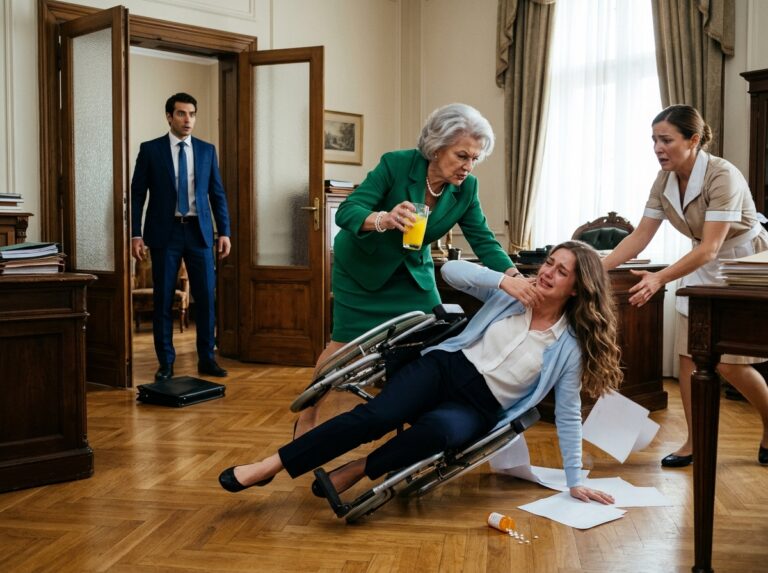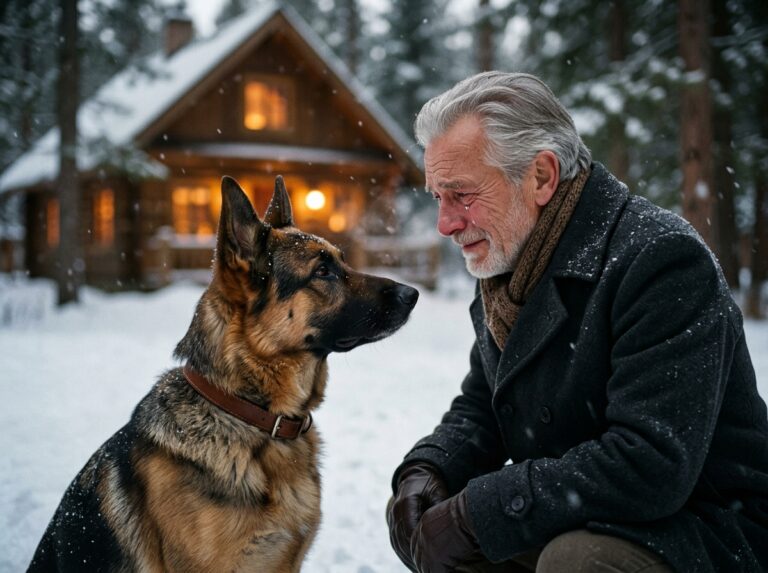
The laughter started before anyone knew who she was.
That was the first mistake.
“Ma’am, the rifle is pointed the wrong direction.”
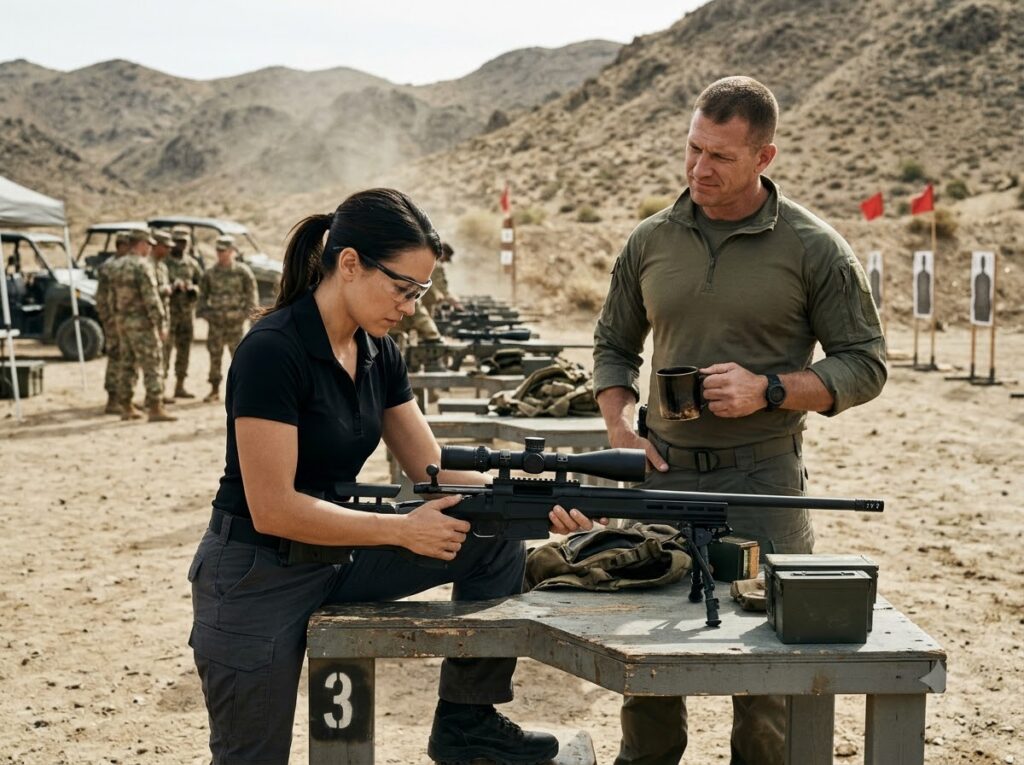
Lieutenant Colonel Ryan Cole’s voice cracked across the Arizona firing range, followed by a laugh sharp enough to turn more than a hundred Special Operations marksmen toward the farthest lane.
The woman standing there didn’t even look up.
Under the washed-out desert sun, she wore a plain black range shirt tucked into dark tactical trousers. Clear safety glasses covered her eyes. Her dark hair was pulled into a tight ponytail. There was no patch on her shoulder, no name strip across her chest, no rank, no unit insignia.
Nothing that explained how she had walked through two guarded gates and onto one of the most restricted shooting ranges in the country.
Nothing that gave Ryan Cole any reason to believe she mattered.
And that was all he needed.
Coffee still in one hand, he left the observation line and walked toward her with an amused grin.
“Hey,” he called louder. “I’m speaking to you.”
She continued inspecting the rifle.
Nearby operators exchanged glances.
“Rough day to be lost,” one murmured.
Someone laughed.
Ryan’s grin widened.
The range stretched behind them in gravel, dust, shimmering heat, and long strips of sun-bleached earth. Red wind flags snapped in the dry air. White number signs stood beside each firing lane.
Far downrange, an 800-meter steel plate looked almost impossibly small against the tan berm.
The woman checked the chamber with steady, practiced fingers.
Ryan stopped beside her.
“First time on a military range?”
“No.”
The answer was quiet.
Not defensive.
Not nervous.
Simply certain.
Ryan’s smile weakened by half an inch.
“No?” he repeated. “Then you understand people don’t just stroll onto this line.”
“I didn’t stroll.”
Several shooters laughed again.
Ryan glanced toward them, pleased with the audience.
At forty-two, Lieutenant Colonel Ryan Cole was broad-shouldered, clean-shaven, and carried himself like a man accustomed to others stepping aside before he reached them.
He had spent seventeen years building a reputation.
Three combat deployments.
Two Purple Hearts.
One Silver Star.
And more qualification records than most of the men watching him could name.
He had commanded in bad places with bad options and had brought nearly everyone home.
People listened when he spoke.
People moved when he gave orders.
And on this range, in particular, people knew something else.
The Cole name meant something.
Ryan’s father, Colonel Thomas Cole, had been one of the most respected marksmen in the unit’s history.
There were still stories about him.
Stories Ryan had grown up hearing.
The most famous involved the very plate standing eight hundred meters downrange.
Five consecutive impacts.
Harsh crosswind.
No correction shot.
No second attempt.
That performance had eventually become part of a qualification benchmark used by several specialized units.
Around the range, older instructors still called it the Cole Standard.
Ryan had spent half his life trying to live up to it.
Now he studied the stranger’s stance.
Then the rifle.
Then, once more, the complete absence of rank.
“You know what’s downrange?” he asked.
“Yes.”
“Distance?”
“Eight hundred meters.”
Ryan smirked.
“At least you can read a marker.”
More laughter rolled down the firing line.
The woman ignored it and settled the rifle stock gently against her shoulder.
Ryan raised a hand.
“Wait. Don’t hurry yourself. We have all morning.”
“I don’t.”
The laughter faded.
Ryan stared at her.
“You don’t?”
“No.”
Something in her calmness irritated him.
She wasn’t trying to impress anyone.
She wasn’t arguing.
She didn’t even appear angry.
She simply behaved as though the range, the watching operators, and Ryan himself were boxes on a list she intended to check off before moving to something more important.
Ryan stepped closer.
“You have a name?”
She adjusted the sling.
“Not one you need yet.”
This time, nobody laughed.
Ryan’s jaw tightened.
“Listen closely,” he said. “This isn’t a civilian gun club. This is a restricted evaluation range. Every person standing here earned the right to be on this line.”
For the first time, the woman turned her head toward him.
Behind the clear lenses, her eyes remained perfectly level.
“I know.”
Ryan leaned toward her.
“Do you?”
“Yes.”
“Then maybe you also know nobody here has landed five consecutive hits on that plate today.”
“I heard.”
Ryan gave a short laugh, but there was no amusement in it now.
“Wonderful. Then you know the standard.”
The woman looked back toward the distant steel.
“I know the old standard.”
A small silence opened.
Then widened.
Ryan’s eyes narrowed.
“What did you say?”
“I said I know the old standard.”
Several operators straightened.
Something about the exchange had shifted.
Ryan placed his coffee on a steel table.
“Old standard,” he repeated coldly. “That’s adorable.”
She said nothing.
Ryan pointed toward the eight-hundred-meter plate.
“That steel has embarrassed better shooters than whoever approved your visitor pass.”
“I don’t have a visitor pass.”
The range went nearly still.
Only the wind flags kept moving.
Ryan looked at her again.
Really looked.
No badge clipped to her belt.
No credentials around her neck.
No escort.
Nothing.
His voice dropped.
“How did you get onto my range?”
“I walked in.”
“You walked in?”
“Yes.”
“Through two gates, an armed checkpoint, and a command building?”
“Yes.”
Several men instinctively looked toward the access road.
Ryan stepped completely into her lane, close enough that his shadow crossed the rifle.
“You think this is funny?”
“No.”
“You think because you watched a couple training videos, you can stand next to professionals?”
“No.”
“Then what exactly are you doing here?”
The woman slowly raised her eyes toward the tiny steel plate shimmering eight hundred meters away.
Her fingers settled around the rifle.
Her breathing never changed.
“Saving time.”
Ryan froze.
Around them, more than one hundred elite marksmen had stopped laughing.
And for the first time that morning, nobody was watching the target.
They were watching her.
Ryan recovered first.
He gave a short, disbelieving smile.
“Saving time doing what?”
The woman rested the rifle on the bench.
“Finding out whether the problem is the shooters.”
Ryan’s expression hardened.
“What problem?”
She glanced toward the digital scoring station thirty yards behind the line.
Three large screens showed lane numbers, shot placement, wind data, and qualification results from the morning’s evaluation.
Red failures filled far more of the screen than anyone liked.
“Twenty-seven shooters evaluated since 0600,” she said. “Seventeen failed the long-range sequence.”
Ryan stared at her.
“How do you know that?”
She continued.
“Nine of those seventeen have historical averages above ninety percent.”
The nearest operators began looking at one another.
Ryan’s voice became quieter.
“How do you know that?”
“Four were instructors last year. One placed first at the joint-service precision competition in March. And Sergeant Bell on Lane Six has never dropped more than one shot at this distance in twelve recorded evaluations.”
A man near Lane Six slowly lowered his arms.
Staff Sergeant Marcus Bell looked stunned.
Ryan glanced at him, then back at the woman.
“You’ve been looking at restricted personnel records?”
“No.”
“Then where did you get those numbers?”
She met his eyes.
“From the system.”
Ryan almost laughed again.
“Which system?”
“The one behind you.”
Nobody laughed this time.
Ryan turned toward the scoring station.
Major Trent Halpern, the range operations officer, was standing there with a headset around his neck.
Halpern lifted both hands.
“Sir, I have no idea what she’s talking about.”
Ryan looked back.
“Neither do I.”
The woman nodded once.
“That’s the problem.”
For the first time that morning, Ryan felt something colder than irritation.
He studied her face for some hint of nervousness.
There was none.
“Who are you?”
She ignored the question.
Instead she said, “May I have the lane?”
Ryan blinked.
“You don’t get to ask me for my firing line.”
“Then order me off it.”
It was so calmly said that for a moment Ryan thought he had misunderstood.
His shoulders squared.
“You’re very close.”
“To what?”
“Being detained.”
She looked toward the access road.
“No, I’m not.”
That answer caused several heads to turn.
Ryan followed their gaze.
Nothing moved on the road.
No convoy.
No security detail.
Just heat rising from the gravel.
He looked back at her.
“All right,” he said. “You want to save time?”
“Yes.”
“Five rounds.”
A murmur passed along the line.
Ryan pointed toward the distant plate.
“Same conditions. Same target. Same scoring system. You put five consecutive rounds on steel, and then you can explain to me how you walked onto my range.”
The woman tilted her head.
“And if I don’t?”
“You leave.”
She considered that.
Then looked past him toward the screens.
“No.”
Ryan smiled.
There it was, he thought.
The retreat.
But then she added, “If the system says I miss, nobody touches the computers.”
Ryan’s smile vanished.
“What?”
“No resets. No corrections. No power cycling. No one leaves the scoring station.”
Major Halpern laughed nervously from behind them.
“This is ridiculous.”
The woman turned her head slightly toward him.
“Especially you, Major.”
Halpern stopped laughing.
Ryan noticed.
Just for an instant.
A tiny change in the operations officer’s face.
Then it was gone.
Ryan stepped aside.
“Fine.”
The woman lowered herself behind the rifle.
The atmosphere along the range changed immediately.
The joking disappeared.
Men who had spent years around firearms recognized something before Ryan was willing to.
She did not move like a visitor.
Everything about her became smaller once she settled behind the weapon.
No unnecessary adjustment.
No repeated checking.
No nervous repositioning.
Her body aligned naturally behind the rifle as if it belonged there.
She rested her cheek against the stock.
Looked through the optic.
Then lifted her head.
“Wind?”
Ryan crossed his arms.
“You tell me.”
She glanced once at the nearest flag.
“Three-quarter value, four to six, variable.”
An instructor twenty feet away slowly lowered his clipboard.
That was exactly the call he had made twenty minutes earlier.
The woman returned to the rifle.
Ryan’s unease deepened.
“Ready?” he asked.
“No.”
She closed her eyes.
One breath.
Two.
Then opened them.
“Now.”
The range safety officer raised his flag.
The line went silent.
The first shot cracked across the desert.
A moment later—
CLANG.
The steel plate answered.
Several men exchanged glances.
Second shot.
CLANG.
Third.
CLANG.
Ryan’s arms slowly unfolded.
Fourth.
CLANG.
The woman paused.
The wind changed.
Flags bent harder to the right.
She waited.
Two seconds.
Three.
Then fired.
CLANG.
A ripple went through the line.
Five rounds.
Five audible impacts.
Someone whispered, “Jesus.”
Ryan said nothing.
The woman remained behind the rifle for another moment.
Then she cleared it, stood, and looked toward the scoring monitors.
The main display flashed.
LANE 12.
SCORE: 4/5.
FAIL.
For one second, nobody moved.
Then several shooters began talking at once.
“That’s wrong.”
“I heard five.”
“Five impacts.”
“Definitely five.”
Staff Sergeant Bell pointed downrange.
“Sir, that was five.”
Ryan stared at the screen.
Then at the target.
Then at the woman.
Her face had not changed.
Not even slightly.
Major Halpern stepped toward the keyboard.
“Probably a sensor issue. I’ll reset—”
“Don’t touch it.”
The woman’s voice wasn’t loud.
It didn’t need to be.
Halpern stopped.
Ryan turned toward him.
“Major.”
“Sir?”
“Step away from the station.”
Halpern hesitated.
Only for a fraction of a second.
But Ryan saw that too.
“Now.”
Halpern stepped back.
The woman removed her safety glasses.
For the first time, Ryan saw her eyes without the transparent barrier between them.
Gray-green.
Steady.
And strangely familiar.
Not because he knew her.
Because he had seen those eyes somewhere before.
A photograph, perhaps.
An old unit wall.
A frame in his father’s study.
He couldn’t place it.
“You knew,” Ryan said.
“Yes.”
“You knew the scoring system would record a miss.”
“I suspected.”
“You came here to test it.”
“Yes.”
Ryan looked toward the monitors.
“So this isn’t about shooting.”
“It was never about shooting.”
Before he could respond, tires crunched on gravel behind them.
Everyone turned.
Three black government SUVs were coming down the access road.
Fast.
They stopped beside the command building.
Doors opened.
The first man out wore a two-star insignia.
Major General Andrew Mercer, deputy commander of the joint special operations training command.
Every conversation on the range died instantly.
Ryan straightened.
So did everyone else.
Mercer walked toward Lane Twelve with two officers and a civilian investigator beside him.
He passed Ryan without stopping.
Then he reached the woman.
And did something no one on the range expected.
He offered her his hand.
“Dr. Vale.”
Ryan heard the name.
Something inside his memory moved.
The woman shook Mercer’s hand.
“General.”
Mercer looked toward the scoring station.
“You confirmed it?”
“Yes.”
“How many?”
“At least seventeen today.”
Ryan stepped forward.
“Sir.”
Mercer finally looked at him.
“Lieutenant Colonel.”
Ryan’s face was rigid.
“With respect, I’d like to know what’s happening on my range.”
The woman answered instead.
“Your range is under a command-level integrity investigation.”
Ryan looked at her.
Mercer continued.
“Effective twenty minutes ago, all evaluation records, system access logs, qualification data, and range communications are frozen.”
A low murmur spread through the operators.
Major Halpern went pale.
Ryan heard the word investigation, but his mind remained stuck on something else.
Dr. Vale.
Vale.
Where had he heard that name?
He looked at her again.
Then it hit him.
An old photograph.
His father’s study.
Five men and one woman standing beside a mud-covered vehicle somewhere overseas.
His father had kept the photograph facedown in a drawer.
Ryan had found it when he was sixteen.
On the back, written in faded ink, were six names.
One of them:
E. Vale.
Ryan’s mouth went dry.
He looked at her.
“No.”
She watched him carefully.
Mercer’s eyes shifted between them.
Ryan took another step.
“Evelyn Vale?”
For the first time, something human flickered across the woman’s face.
Not fear.
Not surprise.
Sadness.
“Yes.”
Ryan actually laughed.
But the sound came out wrong.
“That’s impossible.”
Nobody spoke.
Ryan shook his head.
“Evelyn Vale died nineteen years ago.”
The woman held his gaze.
“That was the story.”
Ryan Cole had been twelve years old when he first heard the name.
His father had come home late from a deployment.
Thomas Cole had been thinner than when he left.
Quiet.
He had hugged Ryan’s mother for nearly a full minute before saying a word.
Then he had walked into Ryan’s bedroom, sat at the edge of the bed, and handed his son a small brass cartridge case.
“Keep this,” Thomas had said.
Ryan had turned it in his fingers.
“What is it?”
“A reminder.”
“Of what?”
His father had stared toward the window for so long Ryan thought he hadn’t heard.
Then Thomas said, “That being right and doing right are not always the same thing.”
Ryan hadn’t understood.
Years later, after Thomas Cole was killed during a training accident, Ryan found the photograph.
Six people.
His father.
Four men Ryan recognized from unit history books.
And one woman.
Evelyn Vale.
The woman had been listed as killed during a classified operation nearly two decades earlier.
There were no public details.
No medals anyone could discuss.
No funeral Ryan knew about.
Just a name occasionally spoken by men who immediately changed the subject afterward.
And now she was standing twenty feet away from him.
Alive.
Ryan’s anger evaporated, replaced by something more unsettling.
“You knew my father.”
Evelyn Vale looked at him.
“Yes.”
“How?”
Mercer interrupted.
“That discussion can happen later.”
Ryan turned.
“Sir, respectfully—”
“Later.”
The general’s tone ended it.
Mercer motioned to the civilian investigator.
“Lock the system.”
Two technicians moved toward the scoring station.
Major Halpern stepped sideways.
One of the investigators noticed.
“Major, remain where you are.”
Halpern stopped.
Ryan looked at him.
There it was again.
That same flicker.
Fear.
And suddenly this stopped being abstract.
Ryan walked toward Halpern.
“Trent?”
Halpern looked at him.
“Sir, I don’t know what this is.”
Ryan studied the man he had worked beside for almost three years.
They had deployed together once.
Shared bad coffee in worse places.
Halpern had attended Ryan’s promotion ceremony.
His wife had eaten Thanksgiving dinner at Ryan’s house.
“Then you’ve got nothing to worry about,” Ryan said.
Halpern nodded too quickly.
“Exactly.”
Behind them, one of the investigators plugged an isolated device into the scoring terminal.
Data began scrolling.
Evelyn stood beside him.
Ryan watched her.
“You expected five impacts to register as four.”
“I expected something close.”
“Why?”
“Because it happened twelve times last month.”
Ryan frowned.
“Nobody reported twelve sensor failures.”
“They weren’t sensor failures.”
“How do you know?”
Evelyn looked at him.
“Because the misses weren’t random.”
She pointed toward the display.
“Every altered sequence changed the fifth shot.”
Ryan’s stomach tightened.
“The fifth?”
“Yes.”
“Why?”
“That’s what I came to find out.”
Staff Sergeant Bell, still nearby, spoke cautiously.
“Ma’am… Dr. Vale… my failure this morning was my fifth shot.”
Evelyn nodded.
“I know.”
Another shooter stepped closer.
“Mine too.”
Then another.
“Same.”
The whispers spread down the range.
Fifth shot.
Fifth shot.
Fifth shot.
Ryan turned toward the 800-meter target.
Five consecutive hits.
The Cole Standard.
Suddenly the phrase felt less like family history and more like a warning.
He looked back at Evelyn.
“You said you knew the old standard.”
Her eyes met his.
“I should.”
Ryan waited.
She did not continue.
He stepped closer.
“My father created it.”
Silence.
Mercer looked away.
That frightened Ryan more than anything else had.
He stared at Evelyn.
“My father created the five-shot standard.”
Evelyn’s expression softened.
“No, Ryan.”
His chest tightened.
She said it quietly.
Almost gently.
“I did.”
The words seemed to erase the desert.
Ryan heard the wind.
The distant rattle of steel.
Someone walking over gravel.
But all of it sounded far away.
“No.”
Evelyn didn’t argue.
Ryan shook his head.
“I’ve read the history.”
“You read the version that was allowed to exist.”
“The standard is named after him.”
“I know.”
“He set the original score.”
“No.”
Ryan looked toward General Mercer.
The general said nothing.
That silence was confirmation.
Ryan’s face flushed.
“You’re telling me my father took credit for your record?”
“No.”
“Then explain it.”
Evelyn’s jaw tightened.
“Your father never asked for the credit.”
“Then why did he get it?”
“Because I disappeared.”
Ryan stared.
Evelyn looked downrange.
“Nineteen years ago, six of us were part of an evaluation cell testing a new precision qualification process. Your father was the senior officer. I was the primary shooter and one of the people who helped build the progression.”
She looked toward the plate.
“The five-round sequence came from me.”
Ryan said nothing.
“We were deployed before the standard was formally published. During that deployment, our team was compromised.”
Her voice changed.
Not weaker.
Older somehow.
“Two people died immediately. One died during extraction. I survived, but the network we were pursuing believed I had information they needed.”
Ryan’s anger vanished.
Evelyn continued.
“So the government let them believe I was dead.”
Ryan glanced at Mercer.
“How long?”
“Nine years,” she said.
“You were officially dead for nine years?”
“Yes.”
“And my father?”
“He knew.”
“Did my mother?”
“No.”
Ryan swallowed.
“Why was his name placed on your standard?”
“Because somebody needed to own it. And because attaching the name of a dead woman to a new military qualification would have raised questions people weren’t permitted to answer.”
Ryan’s face tightened.
“My father could have refused.”
“He did.”
Ryan looked at her.
Evelyn’s voice softened.
“For three years.”
That stopped him.
“He repeatedly requested the attribution be changed or removed. Every request was denied.”
Ryan’s eyes burned.
“He never told me.”
“He couldn’t.”
“After you came back?”
“He tried.”
“When?”
“The week before he died.”
Ryan went completely still.
“What?”
Evelyn reached into a cargo pocket.
Ryan’s entire body tensed.
She removed a small object.
A brass cartridge case.
Ryan stared at it.
The same kind his father had given him when he was twelve.
There was a tiny scratch near its base.
A diagonal line.
Ryan’s breath caught.
His own cartridge case had the same mark.
Evelyn held it in her palm.
“Your father gave me this eighteen years ago.”
Ryan could barely speak.
“Why?”
“He said one day you might need the other half of the story.”
Ryan’s eyes lifted to hers.
Before either could continue, a technician at the scoring station called out.
“General.”
Everyone turned.
The investigator’s face had changed.
Mercer walked over.
“What?”
“We found the alteration routine.”
Ryan followed.
On the display were lines of access records.
Hundreds of them.
The technician pointed.
“The score modification isn’t happening after the shot. It’s embedded in the scoring profile.”
“Meaning?”
“The system receives the impact normally. Then, if certain conditions are met, it rewrites the fifth round as a miss.”
Ryan leaned toward the screen.
“What conditions?”
The technician hesitated.
“Candidate history.”
“What history?”
“Performance, assignment recommendations, selection status.”
Evelyn’s eyes narrowed.
“Show me the filter.”
The technician opened another pane.
Names appeared.
So did categories.
Ryan read them.
And felt sick.
The shooters being failed were not random.
They shared one trait.
Every single one had been recommended for advanced instructor selection or leadership positions.
People who were moving upward.
People who would soon compete for billets currently occupied by someone else.
Ryan slowly looked toward Halpern.
Halpern stepped backward.
“Don’t.”
Ryan’s voice stopped him.
The investigators moved between them.
Halpern raised his hands.
“This proves nothing.”
The technician said, “The routine was installed under an administrator credential.”
Halpern’s face tightened.
“Whose?” Ryan asked.
The technician looked at him.
Then hesitated.
Ryan felt cold before the answer came.
“Yours, sir.”
The entire range seemed to inhale.
Ryan stared at the screen.
“That’s impossible.”
Mercer’s expression hardened.
The technician pointed toward the log.
“Authentication belongs to Lieutenant Colonel Cole.”
Ryan looked from the screen to Evelyn.
Then to Mercer.
“No.”
Nobody answered.
“My credentials are secured.”
The investigator asked, “Who has emergency access?”
“No one.”
“System administrators?”
“Major Halpern has a separate profile.”
Halpern immediately said, “I never used his account.”
Ryan turned on him.
“I didn’t say you did.”
Halpern’s mouth closed.
Evelyn watched both men.
Mercer spoke.
“Lieutenant Colonel Cole, until we determine what happened, you’re relieved of control of the range.”
Ryan’s face changed.
“Sir.”
“That’s an order.”
Ryan looked at the hundred operators behind them.
Men and women who had stopped laughing a long time ago.
Now they were trying not to stare.
Humiliation burned through him.
For one terrible second, Ryan wanted to fight.
To invoke rank.
To demand privacy.
To make somebody else look smaller so he could feel larger.
Then he looked at Evelyn.
She said nothing.
But he remembered his father’s words.
Being right and doing right are not always the same thing.
Ryan removed the command radio from his belt.
He handed it to Mercer.
“Yes, sir.”
Evelyn’s expression shifted almost imperceptibly.
Approval?
Ryan couldn’t tell.
Mercer took the radio.
“Stay available.”
Ryan nodded.
Then stepped away from the firing line he had commanded an hour earlier.
Nobody laughed.
That somehow hurt worse.
By late afternoon, the entire facility was locked down.
The shooters were released in groups after brief interviews.
Computers were seized.
Phones belonging to key staff were secured.
Range personnel were told not to discuss the investigation.
Ryan sat alone in a concrete conference room inside the command building.
His coffee from that morning was still on the range somewhere.
He wondered absurdly who had thrown it away.
The door opened.
Evelyn Vale entered.
Without her safety glasses, she looked less mysterious.
More tired.
She placed a folder on the table.
Ryan didn’t stand.
“Come to tell me I’m finished?”
“No.”
“Then what?”
“To ask a question.”
Ryan laughed bitterly.
“You seem to have plenty.”
Evelyn sat opposite him.
“Why did you embarrass me this morning?”
The question surprised him.
“What?”
“You didn’t know who I was. You thought I was a civilian. Maybe a visitor. Maybe someone who had made a mistake.”
Ryan looked away.
“Why humiliate me?”
He had no answer he liked.
“I run a dangerous range.”
“That isn’t an answer.”
“You were unauthorized.”
“You didn’t know that yet.”
Ryan’s jaw tightened.
“You had no visible identification.”
“So?”
“You didn’t belong there.”
“How did you know?”
Ryan started to reply.
Stopped.
Evelyn leaned back.
“You saw no rank.”
Silence.
“No patch. No name. No unit.”
Ryan said nothing.
“And you decided absence of evidence was evidence of absence.”
His eyes returned to hers.
“That’s a nice phrase.”
“It’s an expensive mistake.”
Ryan exhaled through his nose.
“You came here to investigate software manipulation, and now you’re giving me a leadership lecture.”
“No.”
“Feels like one.”
“I came here to investigate two things.”
Ryan frowned.
“What’s the second?”
“You.”
The room went quiet.
Ryan sat forward.
“Excuse me?”
Evelyn slid the folder toward him.
He didn’t touch it.
“What is that?”
“Your father’s last request.”
Ryan stared at the folder.
Then at her.
“My father has been dead eleven years.”
“Yes.”
“And you’re carrying around his last request?”
“I was instructed to open it under specific circumstances.”
“What circumstances?”
“When you took command of this facility.”
Ryan felt his pulse rise.
“You knew I was coming here?”
“Before you did.”
He looked at the folder.
“What does it say?”
“You’ll read it later.”
Ryan’s irritation returned.
“Then why put it in front of me?”
“Because I need you to understand something first.”
She folded her hands.
“Your father was one of the finest officers I ever knew.”
Ryan’s face remained hard.
“He was also arrogant.”
Ryan blinked.
Evelyn almost smiled.
“You inherited that.”
“Thank you.”
“He was faster than you at recognizing it.”
Ryan looked away.
She continued.
“Thomas believed skill gave him authority over truth. He believed being the best prepared person in a room gave him permission to dismiss people who couldn’t prove themselves fast enough.”
Ryan stared at her.
“You didn’t like him.”
“I loved him.”
The answer hit harder than expected.
Ryan’s eyes narrowed.
Evelyn didn’t look away.
“Not romantically. He was my friend. My commander. My brother when things were bad.”
Ryan relaxed slightly.
“He saved my life twice.”
She paused.
“I saved his three times.”
Despite himself, Ryan almost smiled.
“That sounds like him.”
“It sounds like us.”
For a few seconds, neither spoke.
Then Evelyn said, “Your father changed.”
Ryan looked at her.
“He learned that leadership isn’t proving you’re the strongest person in the room. It’s making sure the room still works when you’re gone.”
Her gaze dropped toward the folder.
“He worried you would inherit his confidence before you inherited that lesson.”
Ryan leaned back.
“So he asked you to judge me.”
“He asked me to observe you.”
“When?”
“Eleven years ago.”
Ryan stared.
“The week before he died?”
“Yes.”
“Why would he think I’d ever command this place?”
Evelyn gave him the faintest smile.
“Because you told him you would.”
Ryan remembered.
Twenty-four years old.
Young officer.
Too proud.
Standing in his father’s garage.
He had said exactly that.
One day I’ll run the range where you set the standard.
Thomas had smiled strangely.
Ryan had forgotten.
His father hadn’t.
Ryan looked at the folder.
“Was this morning a test?”
“No.”
“Don’t lie to me.”
“I’m not.”
“Then why were you there without identification?”
“My access is compartmented. I wasn’t supposed to announce myself until I verified the scoring issue.”
“And you just happened to land in my lane?”
“Yes.”
Ryan stared at her.
She raised one eyebrow.
“Not everything is about you, Lieutenant Colonel.”
That almost made him laugh.
Almost.
Then the conference room door opened.
General Mercer entered.
His face was grim.
“We have a problem.”
Ryan stood automatically.
“What?”
Mercer looked at Evelyn.
“Halpern’s gone.”
Ryan’s stomach dropped.
“What do you mean gone?”
“He was being escorted to an interview room. Fire alarm activated in the west corridor. Cameras dropped for forty-one seconds.”
Ryan swore quietly.
Mercer continued.
“His vehicle is still here.”
Evelyn rose.
“External gates?”
“Locked.”
“Armory?”
“Secure.”
Ryan’s mind moved quickly.
“Range maintenance.”
Mercer looked at him.
“What?”
“There’s an old service corridor behind the target-control building. It connects to drainage access outside the main fence.”
Mercer’s expression sharpened.
“Why isn’t it on the security map?”
“It was sealed three years ago.”
Evelyn was already moving.
Ryan followed.
Mercer blocked him.
“You’re relieved.”
Ryan looked at him.
“I know that building better than anyone here.”
“You’re also potentially implicated.”
Ryan’s face hardened.
“Then put someone behind me.”
Mercer hesitated.
Evelyn said, “He comes.”
Mercer looked at her.
“Why?”
“Because if Halpern used his credentials, he may know what else Halpern accessed.”
Ryan stared.
Mercer finally nodded.
“Fine. You stay with security.”
Ryan didn’t argue.
They moved.
The maintenance building was empty.
One rear door stood open.
Beyond it, desert light flooded a concrete passage half-filled with windblown sand.
A security team entered first.
Ryan followed with Evelyn.
“Why would Halpern run?” Ryan asked.
“Because the software isn’t the whole problem,” Evelyn said.
“You know something else.”
“I suspect.”
“What?”
She looked at him.
“The altered scores started six months ago.”
“So?”
“Your advanced instructor board started seven months ago.”
Ryan stopped walking.
Evelyn continued.
“Someone has been systematically damaging the records of candidates likely to compete for senior training positions.”
“Halpern?”
“Possibly.”
“Why?”
“You tell me.”
Ryan thought.
Then his expression changed.
“Promotion.”
Evelyn nodded.
“Your position opens a full colonel billet next year.”
“And range operations becomes the likely successor.”
“Yes.”
Ryan clenched his jaw.
“So he ruins everyone who could compete with him.”
“That’s the simple explanation.”
“You don’t believe the simple explanation.”
“Usually not.”
They reached the service corridor.
A security officer held up a hand.
Footprints.
Fresh.
Moving toward the drainage exit.
Then something buzzed on Ryan’s belt.
His personal phone.
Everyone looked at him.
The device had been returned after investigators cloned it.
Unknown number.
Ryan answered.
“Cole.”
Silence.
Then Halpern’s voice.
“You should’ve stayed arrogant, Ryan.”
Ryan’s face tightened.
“Where are you?”
“You were easier to manage when you thought you were untouchable.”
Evelyn motioned for the security team to begin tracing.
Ryan kept him talking.
“What did you do?”
Halpern laughed softly.
“You really think this is about promotion?”
“What is it about?”
“The old standard.”
Evelyn’s eyes sharpened.
Halpern continued.
“You worshipped that thing your whole life. Your father’s precious five shots. The great Thomas Cole.”
Ryan said nothing.
“You never asked who got destroyed so his legend could exist.”
Ryan looked at Evelyn.
Her face had gone still.
“Who?”
Halpern breathed into the phone.
“My father.”
Evelyn closed her eyes.
Ryan saw recognition.
“Who was your father?” he asked.
Halpern answered with two words.
“Daniel Maddox.”
Evelyn whispered, “No.”
Ryan looked at her.
She knew the name.
Halpern heard her.
“Oh, she remembers.”
Evelyn stepped closer to the phone.
“Trent.”
Silence.
Then Halpern laughed.
“There she is.”
Evelyn’s face had lost color.
“You were six.”
“Seven.”
“What are you doing?”
“Correcting history.”
Evelyn shook her head.
“Your father died because he compromised the team.”
Ryan looked at her sharply.
Halpern’s voice exploded.
“That’s what Thomas told everyone!”
“No,” Evelyn said. “That’s what I told them.”
Silence.
Even Ryan stopped breathing for a second.
Halpern’s voice became low.
“What?”
Evelyn stared into the distance.
“I wrote the report.”
Ryan’s eyes widened.
Halpern did not speak.
Evelyn continued.
“Your father wasn’t betrayed by Thomas Cole.”
She swallowed.
“He betrayed us.”
The phone remained silent.
Evelyn’s voice shook for the first time.
“He transmitted our position. Three people died because of it.”
“No.”
“I watched him do it.”
“You’re lying.”
“I wish I were.”
“You ruined his name.”
“His name was sealed. Nobody outside six people ever knew.”
“My mother knew.”
That stopped Evelyn.
Halpern laughed, but the sound broke.
“She spent twenty years believing Thomas Cole killed him to protect his own career.”
Evelyn closed her eyes.
Ryan understood.
A lie created to protect national security had become another lie inside a grieving family.
Halpern had grown up with it.
Fed on it.
Built his life around it.
Ryan spoke carefully.
“So you falsified scores because of my father?”
“Not just scores.”
Ryan went still.
“What else?”
Halpern said nothing.
Then the line disconnected.
A security officer swore.
“We lost him.”
Evelyn looked at Ryan.
“Not just scores.”
Ryan’s face changed.
He turned and ran.
“Where?” Evelyn called.
“THE TARGET SYSTEM.”
They reached the control room three minutes later.
Ryan shoved through the door.
Technicians were working over terminals.
“Shut down all automated target movement.”
One technician looked confused.
“Sir?”
“Now!”
Mercer entered behind them.
“What’s happening?”
Ryan pointed at the screen.
“The long-range system doesn’t just score.”
Evelyn understood first.
“It controls target position.”
Ryan nodded.
“Some lanes use remote elevation mechanisms.”
Mercer’s voice hardened.
“Can they create a hazard?”
“Not if safeties work.”
Evelyn looked at him.
“And if Halpern changed more than scores?”
Nobody answered.
A technician began typing.
“Sir, someone disabled the maintenance interlocks.”
Ryan felt ice spread through his chest.
“How many?”
“Three lanes.”
“Which?”
The technician read them.
“Six. Twelve. Seventeen.”
Ryan looked at Evelyn.
Lane Twelve.
Her lane.
“Why those?”
The technician opened the sequence history.
Then froze.
“What?”
“There are scheduled activations.”
“When?”
The technician looked at the clock.
“Two minutes.”
Ryan grabbed the radio.
“Evacuate the firing line. Everyone behind the hard barrier immediately.”
Mercer stared at him.
“The line is already closed.”
“Maintenance crews.”
Mercer grabbed another radio.
“Account for everyone.”
Voices erupted.
Names.
Locations.
Teams.
Then someone shouted over the channel.
“Two technicians are still downrange.”
Ryan’s stomach dropped.
“Where?”
“Target pit seventeen.”
Ryan didn’t think.
He ran.
Evelyn caught his arm.
“Ryan.”
“Two people are out there.”
“Security can—”
“Not in two minutes.”
He pulled free.
“Your father told me you did this,” Evelyn said.
Ryan stopped.
“What?”
She stared at him.
“He said you always ran toward the thing you were supposed to think about first.”
Despite everything, Ryan laughed once.
“Sounds like him.”
Then he ran.
Evelyn swore and followed.
They crossed the range access path in a utility vehicle, dust boiling behind them.
Ninety seconds.
Ryan pushed it as fast as the terrain allowed.
At the seventeenth target pit, two civilian technicians were halfway out of a maintenance trench.
“What are you doing?” one shouted.
“MOVE!”
They saw Ryan’s expression and stopped asking questions.
One climbed clear.
The other stumbled.
Evelyn grabbed him under the arm.
Ryan heard machinery engage.
A deep electric whine beneath the ground.
“Go!”
They ran toward the vehicle.
Behind them, a target frame slammed upward violently, far faster than its normal speed.
A metal brace sheared.
The frame twisted.
A heavy section crashed into the trench where the technician had been standing seconds earlier.
Dust exploded.
Everyone froze.
Then the technician whispered, “Oh my God.”
Ryan turned toward Evelyn.
She was staring at the broken mechanism.
“That wasn’t a scoring prank.”
“No.”
“Halpern knew people could get hurt.”
“Yes.”
Ryan’s face hardened.
“He’s done.”
Evelyn looked at him.
“Now you sound like your father.”
“Good.”
“No.”
Ryan frowned.
Evelyn stepped closer.
“Your father sounded exactly like that the night everything went wrong.”
The words stopped him.
“Anger makes decisions feel simple,” she said. “They rarely are.”
Ryan stared at her.
Then looked at the frightened technicians.
He forced himself to breathe.
“What would you do?”
Evelyn looked toward the distant facility.
“Find out what he wants before deciding what he deserves.”
They didn’t have to wait long.
Halpern called again.
This time, Evelyn answered.
“Trent.”
“You finally told him.”
“Yes.”
“My father was a traitor?”
“Yes.”
A long pause.
Then a whisper.
“My mother died believing Thomas Cole murdered him.”
Evelyn’s expression broke slightly.
“I’m sorry.”
“Don’t.”
“It’s true.”
“You could have told her.”
“No.”
“You chose the mission over her.”
“Yes.”
Halpern breathed hard.
Evelyn didn’t defend herself.
That seemed to disarm him more than an argument would have.
Finally he said, “I found the archive.”
Evelyn’s eyes sharpened.
“What archive?”
“Thomas Cole’s.”
Ryan looked at her.
Halpern continued.
“He kept everything.”
“That’s impossible,” Evelyn said.
“No. He kept a duplicate.”
Ryan whispered, “My father?”
Halpern heard him.
“Your hero was terrified the official record would erase the truth. He copied operation files, after-action notes, evaluations. Everything.”
Evelyn looked shaken.
“Where?”
Halpern laughed.
“You really don’t know.”
“No.”
“It’s here.”
Ryan frowned.
“Where here?”
“The range.”
The line disconnected.
Ryan and Evelyn stared at each other.
Then Ryan remembered something.
A room his father used to complain about.
Before the current command building was constructed, Thomas Cole had spent months helping design the original range facilities.
There was an old records bunker beneath the observation structure.
Officially empty for years.
Ryan looked toward the range.
“Come on.”
The bunker door had been welded shut.
Or appeared to be.
Behind a storage rack, Ryan found new scratches on the floor.
The rack had been moved recently.
Security cut the old lock.
The door opened.
Cold, stale air drifted upward.
A narrow staircase descended into darkness.
Ryan went first.
Evelyn behind him.
Mercer and two security officers followed.
At the bottom, they found shelves.
Boxes.
Old training manuals.
Film canisters.
Paper files.
And against the far wall, one military footlocker.
RYAN recognized it immediately.
Dark green.
Faded white lettering.
T. COLE.
He had seen it in his father’s garage when he was a child.
Ryan approached slowly.
The lock had been broken.
Inside were dozens of folders.
Photographs.
Notebooks.
Old digital storage devices.
And one sealed envelope.
Written across it in his father’s handwriting were three words.
FOR EVELYN VALE.
Ryan stepped back.
Evelyn looked as if the air had been knocked from her lungs.
“Open it,” Mercer said.
She didn’t move.
Ryan picked it up and handed it to her.
Her fingers trembled.
It was the first time Ryan had seen them do that.
She broke the seal.
Inside was a single sheet of paper.
She read silently.
Then stopped.
“What?” Ryan asked.
Evelyn lowered the page.
Her eyes were wet.
“Read it.”
She handed it to him.
Ryan recognized his father’s handwriting instantly.
Evelyn,
If you’re reading this, either I got old enough to become sentimental or I didn’t get old at all.
I hope it was the first.
There are things we buried because we believed secrecy and honor were the same thing. They aren’t.
Maddox betrayed us. That is true.
But the rest of the story belongs to you.
The standard belongs to you.
The shot belongs to you.
And if my name is still attached to either one when this can finally be told, remove it.
Ryan stopped reading.
His eyes burned.
He continued.
There is one more thing.
My son wants my life.
I pray he never gets it.
He wants the reputation, the command, the certainty. He thinks authority means never being the smallest man in the room.
If Ryan ever reaches the point where he commands that range, do me one final favor.
Don’t test whether he can shoot.
I know he can.
Find out whether he can be wrong.
If he can’t, remove him before he gets someone killed.
If he can, tell him I was proud of him long before he ever earned anything worth putting on a uniform.
—Thomas
Ryan stopped.
Nobody spoke.
He read the last lines again.
Then once more.
Find out whether he can be wrong.
He lowered the letter.
For the first time since he was twelve years old, Lieutenant Colonel Ryan Cole cried because of his father.
Not dramatically.
Not loudly.
One tear escaped.
He wiped it away angrily.
Then laughed at himself.
Evelyn’s eyes were wet too.
“He really wrote this?”
“Yes.”
“He knew?”
“He knew you.”
Ryan looked around the bunker.
“Why leave all this here?”
Evelyn studied the files.
“Insurance.”
“Against what?”
“History.”
Mercer moved toward another folder.
“General,” Evelyn said sharply.
He stopped.
She looked at Ryan.
“Your father believed classified truths eventually needed daylight. He must have kept enough documentation to correct the record when the operations were declassified.”
Ryan looked down.
There were dozens of envelopes.
Names.
Dates.
People who had died.
People who had survived.
Then a sound came from behind them.
The click of a pistol being cocked.
Everyone froze.
Halpern stood at the bottom of the stairway.
Dust covered his uniform.
His face looked exhausted.
The weapon shook slightly in his hand.
Security officers began moving.
“Don’t.”
Halpern aimed toward the boxes.
“Everybody stay where you are.”
Ryan stared at him.
“Trent.”
“Move away from the files.”
Evelyn stepped forward.
“Those files prove what happened to your father.”
“I know.”
“Then why destroy them?”
“Because they prove he was a traitor.”
The words broke in his throat.
Ryan understood.
Halpern hadn’t wanted the truth.
He had wanted vindication.
And now that the truth contradicted the story he had built his entire life around, he couldn’t bear it.
Ryan took one slow step.
Halpern swung the weapon toward him.
“Stop.”
Ryan stopped.
“You framed me.”
“Yes.”
“Why?”
Halpern’s eyes filled with hatred.
“Because a Cole was going to lose everything.”
Ryan nodded.
“And the candidates?”
“Necessary.”
“You ruined careers.”
“They’d recover.”
“The target mechanism could have killed two civilians.”
Halpern looked away.
“That wasn’t supposed to happen.”
“But it did.”
Ryan’s voice stayed calm.
For perhaps the first time that day, he understood what Evelyn had meant.
Anger wanted simplicity.
Leadership required something harder.
Ryan removed his rank insignia from his collar.
Slowly.
He placed it on the footlocker.
Halpern frowned.
“What are you doing?”
“You hate my name?”
“Yes.”
“My rank?”
Halpern said nothing.
“My father?”
Halpern’s grip tightened.
Ryan stepped away from the insignia.
“Then forget all three.”
Evelyn watched him.
Ryan raised his empty hands.
“I’m just Ryan.”
“Don’t.”
“Your father died when you were seven.”
Halpern’s face twitched.
“Shut up.”
“You grew up hearing one version.”
“I said shut up.”
“You built everything around it.”
Halpern’s eyes filled.
Ryan continued.
“And now you found out the man you hated didn’t do what you thought.”
Halpern’s weapon shook harder.
Ryan’s voice softened.
“That doesn’t make your grief fake.”
Halpern stared at him.
“But what you did afterward is still yours.”
Silence.
“You can’t fix your father.”
Ryan nodded toward the files.
“But you can stop destroying other people for him.”
For a long moment, nothing happened.
Then Halpern looked at Evelyn.
“Did he suffer?”
Evelyn knew who he meant.
She answered honestly.
“No.”
Halpern’s face collapsed.
The weapon lowered.
Security moved instantly.
Within seconds, he was disarmed.
Handcuffed.
Led toward the stairs.
As he passed Evelyn, he stopped.
“Was there anything good in him?”
The security officers waited.
Evelyn swallowed.
“Yes.”
Halpern looked at her.
“He was brave,” she said. “Until fear changed him.”
Halpern closed his eyes.
Then nodded.
They led him away.
Ryan stood in the bunker long after the footsteps disappeared.
Finally Evelyn picked up his rank insignia from the footlocker.
She held it out.
He looked at it.
“I’m probably not getting to keep that.”
“That isn’t my decision.”
Ryan smiled faintly.
“I thought evaluating me was the second reason you came.”
“It was.”
“And?”
Evelyn considered him.
“This morning, I would have removed you.”
Ryan nodded.
“I figured.”
“An hour ago, I wasn’t sure.”
“And now?”
She placed the insignia in his palm.
“Now I think your father may have known what he was doing.”
The investigation lasted six weeks.
Major Trent Halpern confessed to installing the scoring manipulation routine and using Ryan’s credentials after copying an emergency authentication token months earlier.
He admitted targeting high-performing candidates, partly to strengthen his own promotion prospects and partly because he believed humiliating the Cole command would expose what he thought was an old family fraud.
The dangerous target-system modification had been intended to trigger shutdowns and embarrass Ryan during the investigation.
Instead, it nearly injured two technicians.
Halpern faced criminal charges.
Seventeen shooters had their evaluations restored.
Eleven more historical records were reviewed and corrected.
Ryan Cole was cleared of involvement in the manipulation.
But he was not cleared of everything.
General Mercer’s report criticized his command climate.
Sharp language.
Public humiliation.
An atmosphere in which junior personnel were often reluctant to challenge assumptions.
Ryan read every page.
He didn’t appeal a sentence.
That surprised almost everyone.
Then he did something that surprised them more.
On his first morning back in command, Ryan walked onto the firing line without coffee.
The entire group snapped to attention.
He looked at them.
“At ease.”
They relaxed.
Ryan stood quietly for several seconds.
“I owe some of you an apology.”
Confused expressions moved through the formation.
Ryan continued.
“I believed standards were weakened when authority was questioned.”
He looked toward Lane Twelve.
“I was wrong.”
The words seemed difficult for him.
Which was precisely why everyone listened.
“A professional who can’t be corrected becomes dangerous. A leader who humiliates people for not displaying status is worse.”
Several shooters exchanged glances.
Ryan took a breath.
“So from today forward, if something looks wrong, you say it. Rank doesn’t make bad information better.”
Then he looked toward Staff Sergeant Bell.
“Sergeant.”
Bell straightened.
“Yes, sir?”
“Your fifth shot last month was a hit.”
Bell smiled.
“Yes, sir.”
Ryan nodded.
“I know.”
A few men laughed.
This time Ryan laughed with them.
Near the observation building, Evelyn watched in silence.
She had returned for one final administrative meeting.
She was leaving that afternoon.
Ryan found her beside the 800-meter lane.
“You always disappear without saying goodbye?”
“Usually.”
“Habit?”
“Useful one.”
He stood beside her.
For a while they looked downrange.
The steel plate shimmered beneath the Arizona sun.
Ryan finally said, “I looked up the declassification schedule.”
Evelyn’s expression became guarded.
“The operation files can be released next year.”
“Some of them.”
“And the standard?”
She glanced at him.
“What about it?”
“I submitted the paperwork.”
“For?”
Ryan looked toward the plate.
“Renaming it.”
Evelyn went very still.
“No.”
“It isn’t mine to decide.”
“No.”
“It wasn’t my father’s either.”
“Ryan.”
He smiled.
“You sound nervous.”
“I’m serious.”
“So am I.”
Evelyn folded her arms.
“I don’t want my name on a shooting standard.”
“Why?”
“Because people will turn it into a legend.”
Ryan considered that.
“Probably.”
“And legends are dangerous.”
“So my father discovered.”
Her eyes softened.
Ryan continued.
“That’s why I didn’t request the Vale Standard.”
Evelyn frowned.
“What did you request?”
“The Fifth Round Principle.”
She stared.
Ryan explained.
“The fifth round is the one everybody thinks proves how good you are.”
He looked at her.
“But that isn’t what we learned here.”
“What did we learn?”
“The fifth round is where people reveal whether they trust what they know more than what the system tells them.”
Evelyn said nothing.
Ryan smiled faintly.
“I thought you’d hate it less.”
“I do hate it less.”
“High praise.”
They stood there quietly.
Then Evelyn reached into her pocket.
She removed the brass cartridge case.
The one Thomas Cole had given her.
She handed it to Ryan.
“No.”
“Take it.”
“I already have one.”
“I know.”
Ryan looked at her.
“How?”
“Your father told me.”
Ryan accepted the brass.
Now he had two.
Matching scratches.
Two halves of a story.
“Why did he mark them?”
Evelyn smiled.
“That,” she said, “I promised not to tell you.”
Ryan stared at her.
“You’re serious?”
“Completely.”
“After all this?”
“Some mysteries are healthy.”
She started walking away.
Ryan laughed.
Then called after her.
“Evelyn.”
She stopped.
He hesitated.
“What was he like at the end?”
Her expression changed.
Ryan’s smile disappeared.
“My father.”
Evelyn looked toward the mountains.
“Happy.”
Ryan swallowed.
“You were there?”
“No.”
“Then how do you know?”
She looked back at him.
“Because he called me the night before.”
Ryan’s eyes widened.
“He called you?”
“Yes.”
“What did he say?”
Evelyn smiled sadly.
“He said you had finally beaten his time on the moving-target sequence.”
Ryan remembered that night.
He had been thirty-one.
He had called his father from the range like an excited teenager.
Thomas had pretended not to care.
Apparently, he had cared very much.
Evelyn continued.
“He wouldn’t stop talking about you.”
Ryan lowered his head.
Then laughed through the sudden pressure behind his eyes.
“That sounds unlike him.”
“No.”
Evelyn walked closer.
“That sounds exactly like him when you weren’t in the room.”
She squeezed his shoulder once.
Then left.
Ryan remained beside Lane Twelve.
For almost a minute, he simply stared at the distant steel plate.
Then the range safety officer approached.
“Sir?”
Ryan cleared his throat.
“Yes?”
“We’re ready for the afternoon evaluation.”
Ryan nodded.
The officer hesitated.
“One question.”
“What?”
“We still using five consecutive hits?”
Ryan looked toward the target.
Five rounds.
The standard his father had been credited with.
The standard Evelyn Vale had actually created.
The standard Halpern had corrupted.
The standard that had brought nineteen years of buried history back into daylight.
Ryan smiled.
“Yes.”
The officer turned to leave.
Then Ryan added, “But if the computer disagrees with what you heard, check the computer.”
The officer grinned.
“Yes, sir.”
Ryan watched the firing line fill.
Young operators.
Experienced instructors.
People with impressive resumes.
People nobody had heard of yet.
Some wore rank.
Some did not.
And suddenly Ryan noticed how little that told him.
He reached into his pocket and felt the two brass cartridge cases.
Then the first rifle cracked.
Steel rang in the distance.
CLANG.
Ryan listened.
Second shot.
CLANG.
Third.
CLANG.
Fourth.
CLANG.
The shooter paused.
Wind shifted across the range.
Ryan watched the flag.
The entire firing line waited.
Then came the fifth shot.
CLANG.
The screen flashed.
4/5.
For half a second, nobody moved.
Then the young shooter slowly looked toward Ryan.
Six weeks earlier, Ryan Cole would have pointed at the monitor.
He would have trusted the system.
He would have told the shooter to accept the failure and move on.
Instead, Ryan smiled.
“Cease fire.”
The range went quiet.
He walked toward the scoring station.
The technician looked nervous.
“Sir, the monitor says—”
“I know what it says.”
Ryan glanced toward the steel.
Then toward the shooter.
“I heard five.”
The young operator stared at him.
Ryan pointed at the computer.
“Check it.”
As the technician began reviewing the data, Ryan turned toward Lane Twelve.
For just a moment, through the desert heat, he could almost see Evelyn standing there again.
Black shirt.
Clear glasses.
No rank.
No patch.
No name.
A woman he had decided was nobody because nothing on her clothing told him she was somebody.
He understood now why his father had left the letter.
Why Evelyn had carried it for eleven years.
Why the real test had never been five shots at eight hundred meters.
The old standard was never about hitting steel.
It was about what happened after certainty failed.
And Ryan believed that was the end of the story.
He was wrong.
Because three months later, while the sealed Thomas Cole archive was being cataloged for declassification, an analyst found something hidden inside the bottom of the old footlocker.
A false panel.
Inside it sat a tiny envelope.
No military markings.
No classification stamp.
Just two handwritten words.
FOR RYAN.
Ryan was called to headquarters.
Evelyn came too.
He opened the envelope with her sitting across from him.
Inside was one photograph.
The same six-person team.
Thomas Cole.
Evelyn Vale.
Daniel Maddox.
Three others.
But this photograph had been taken several seconds after the famous version Ryan remembered.
Everyone was laughing.
Even Maddox.
On the back, Thomas had written:
The truth is never one photograph.
Below that was a date.
And beneath the date, another sentence.
Ryan read it twice.
Then his face went white.
Evelyn leaned forward.
“What?”
He handed her the photograph.
She read the line.
Her hands began trembling.
Because Thomas Cole had written something neither of them knew.
Something that changed the meaning of everything they had uncovered.
Maddox did not transmit our position willingly.
Evelyn stared at Ryan.
“No.”
Ryan turned over the second paper inside the envelope.
A handwritten intelligence reference number appeared at the top.
Beneath it:
He was coerced. His son had been identified and threatened. Maddox believed the threat was real.
Evelyn stopped breathing.
Trent Halpern had been seven years old.
His father had betrayed the team because someone threatened his child.
Ryan continued reading.
Evelyn saw the transmission but never knew why. Command buried the coercion because acknowledging it would expose the source that identified his family.
Evelyn covered her mouth.
All these years, she had believed Daniel Maddox betrayed them from fear or greed.
All these years, Halpern had believed Thomas Cole murdered his father’s reputation.
Both stories had been wrong.
Ryan read the final paragraph.
If this file is ever opened, tell Evelyn she was right about one thing and wrong about another.
She was right that Maddox endangered us.
She was wrong that fear made him a coward.
He chose his son.
I don’t know whether that excuses what happened.
I only know I’m no longer certain I would have chosen differently.
The room was silent.
Evelyn’s eyes filled with tears.
“My God.”
Ryan looked at her.
“He knew.”
She nodded.
“Your father knew.”
“And never told you.”
“He couldn’t.”
The same words she had once used to explain herself.
Now they belonged to Thomas.
Evelyn laughed once through tears.
“That stubborn bastard.”
Ryan looked down at the photograph.
Something still bothered him.
“Why hide this separately?”
Evelyn didn’t answer.
Ryan inspected the envelope.
A second fold was glued inside the paper.
He opened it.
Another tiny note fell out.
This one contained only a few lines.
Ryan read them.
Then slowly sat back.
“What?” Evelyn asked.
He gave her the note.
She read.
And this time she didn’t cry.
She simply stared.
Thomas had written:
If Ryan and Evelyn are reading this together, then the first part worked.
If Ryan is reading it alone, he probably failed her test.
Ryan blinked.
Evelyn’s mouth fell open.
Then, against every expectation, she began laughing.
Ryan stared.
“He planned this?”
She laughed harder.
“That impossible man.”
Ryan took the note back.
There was one final line.
The five-shot standard was Evelyn’s idea. The character test was mine.
Ryan stared at it.
Then started laughing too.
His father had been dead eleven years.
And somehow Thomas Cole had still managed to arrange one last evaluation.
Not through computers.
Not through orders.
Through people.
Through truth.
Through a woman with no visible rank walking onto his son’s range and giving him every possible opportunity to reveal who he had become.
Ryan shook his head.
“He knew you’d provoke me.”
Evelyn wiped her eyes.
“I did not provoke you.”
“You told me your name wasn’t one I needed.”
“It wasn’t.”
“You said you walked through the gate.”
“I did.”
“You could have shown me credentials.”
“I could have.”
Ryan pointed at her.
“You enjoyed that.”
“Maybe a little.”
He laughed.
Then his expression softened.
“My father trusted you with this.”
Evelyn looked at the old photograph.
“No.”
Ryan frowned.
“He trusted you.”
She slid the photograph across the table.
“Look again.”
Ryan looked.
Thomas Cole wasn’t looking at the camera.
He was looking at Evelyn.
She wasn’t looking at the camera either.
She was looking toward Daniel Maddox.
Maddox was crouched beside a radio, laughing.
Six people caught in a moment before history hardened them into heroes, traitors, victims, and ghosts.
Evelyn spoke quietly.
“Your father didn’t trust me with the truth.”
Ryan looked up.
“He trusted both of us to eventually become people who could survive it.”
That was different.
And somehow larger.
A year later, portions of the operation were declassified.
Daniel Maddox’s record was amended.
Not cleared.
He had still transmitted information that led to deaths.
But the coercion was acknowledged.
His family received the truth.
Trent Halpern learned it while awaiting sentencing.
Ryan visited him once.
Only once.
Halpern sat behind thick glass in a detention facility.
For several seconds, neither man spoke.
Finally Ryan slid a copied page beneath the viewing panel.
Halpern read it.
His face collapsed.
“My father…”
Ryan nodded.
“He was trying to save you.”
Halpern pressed one hand against his eyes.
Ryan waited.
After a long time Halpern whispered, “Why bring me this?”
Ryan thought about the answer.
Then said, “Because somebody should have brought it to your mother twenty years ago.”
Halpern looked at him.
Ryan stood.
“Does this change what happens to me?” Halpern asked.
“No.”
Halpern nodded slowly.
“Good.”
Ryan turned to leave.
“Ryan.”
He stopped.
Halpern looked at him through the glass.
“Your father wasn’t the man I thought he was.”
Ryan almost smiled.
“Neither was yours.”
Then he left.
At the range, the old nickname gradually disappeared.
Men stopped calling the qualification the Cole Standard.
Official documents called it something else.
But among the shooters, a new phrase took hold.
The Fifth Round.
New operators were told a simple story.
Not about legends.
Not about impossible shots.
About a morning when a woman without a rank patch fired five rounds.
The computer said four.
And everyone had to decide what they trusted.
Ryan heard younger instructors telling the story sometimes.
They usually exaggerated.
They made Evelyn colder.
Ryan angrier.
The wind stronger.
The shot farther.
That was what stories did.
They turned people into symbols.
Whenever Ryan heard them drifting too far, he corrected one thing.
“Dr. Vale wasn’t there to prove she could shoot.”
Someone would inevitably ask, “Then what was she there for?”
Ryan always gave the same answer.
“To find out who was paying attention.”
Years later, when Ryan finally left command, he took one last walk down the firing line.
The desert looked exactly as it had that morning.
Harsh sun.
Dust.
Wind snapping at the flags.
Eight-hundred-meter steel plate.
A young captain approached him.
“Sir, before you go, can I ask you something?”
Ryan smiled.
“Sure.”
“Is it true Dr. Vale outshot the entire unit that day?”
Ryan laughed.
“No.”
The captain looked disappointed.
“She only fired five rounds.”
“That’s it?”
“That’s it.”
“Then why does everyone talk about it?”
Ryan looked toward the plate.
Because he finally understood the answer.
“Because the shots were the least important thing she did.”
The captain considered that.
Ryan reached into his pocket.
He still carried one of the brass cartridge cases.
The second one sat framed beside his father’s letter at home.
He rolled the brass between his fingers.
For most of his life, Ryan Cole had believed greatness announced itself.
Through rank.
Through reputation.
Through medals.
Through names people recognized.
He had been wrong.
Sometimes greatness walked quietly through two guarded gates.
Sometimes it wore no insignia.
Sometimes it let people laugh.
Sometimes it never bothered telling anyone who it was.
And sometimes the most important test of a man’s life began with him looking directly at someone extraordinary—
and deciding she didn’t belong.
Ryan smiled toward the empty twelfth lane.
Then turned away from the range for the last time.
Behind him, a rifle cracked.
A second later, steel rang beneath the Arizona sun.
CLANG.
Then another.
CLANG.
Another.
CLANG.
A fourth.
CLANG.
There was a pause before the fifth.
Ryan stopped walking.
The final shot echoed across the desert.
CLANG.
He smiled.
And kept walking.
Because by then, he finally understood what his father, Evelyn Vale, Daniel Maddox, and even Trent Halpern had all learned at terrible cost:
The hardest part of any standard is not proving that you are right.
It is having the courage to discover that you were wrong—and becoming someone better before the next shot is fired.