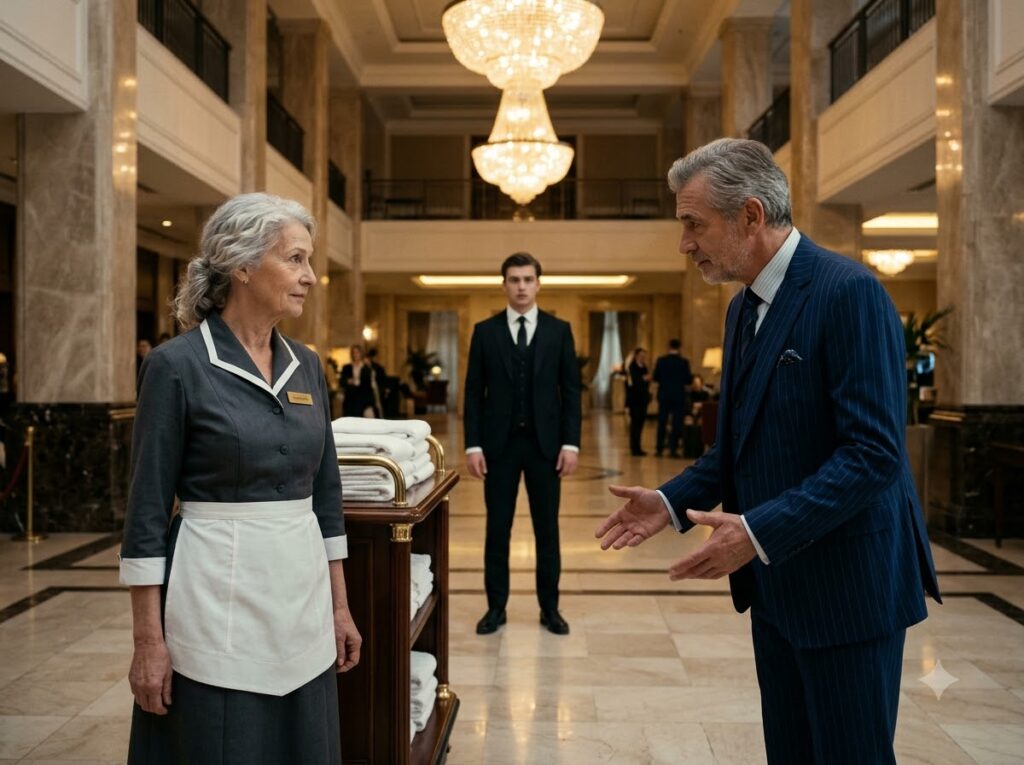
In one of the city’s most prestigious hotels, an elderly woman was slowly arranging some towels in a fifth-floor corridor.
She wore a simple maid’s uniform, and no one seemed to pay her any particular attention.
At one point, a young guest arrived, dressed in expensive clothing.
“Move aside, please. I’m staying in the VIP suite, and I’m in a hurry.”
The woman moved her cart to the side without a word of protest.
The young man glanced at her and added:
“People like you should work without being noticed.”
The woman did not reply.
A short while later, she went down to the lobby.
As soon as the hotel manager saw her, he immediately left the reception desk and walked toward her.
“Mrs. Conti, the board of directors is waiting for you.”
The young guest, who was standing nearby, looked confused.
“Her?”
The manager turned to him.
“Mrs. Conti is the widow of the hotel’s founder and the group’s principal shareholder.”
The young man’s expression shifted.
Beatrice Conti had helped build the hotel alongside her husband more than forty years earlier. After his passing, she had entrusted the day-to-day operations to the management team, yet she continued to personally oversee all major decisions.
That morning, she had chosen to wear an old uniform and walk through the hotel, unrecognized.
She wanted to see what happened when no one suspected that the owner might be present.
During the meeting, Beatrice spoke about what she had observed.
Some employees had been kind and professional.
Others seemed to change their attitude depending on a person’s attire, the type of room they had booked, or their perceived importance.
Then, she recounted what had taken place in the corridor.
The manager immediately suggested revoking the young guest’s VIP privileges.
Beatrice, however, stopped him. “I don’t want revenge. I want to understand why we’ve created an environment where someone thinks that paying for an expensive suite gives them the right to humiliate those who work here.”
The young man, summoned shortly thereafter, expected to be fired.
Instead, Beatrice spoke to him calmly.
“My husband used to say that a hotel’s value isn’t defined by its marble, its star rating, or the price of its rooms. It’s defined by how people are treated the moment they walk through that door.”
The man lowered his gaze and apologized.
From that day on, the hotel revised its VIP program: special privileges and services would never again be accepted as a justification for offensive behavior toward the staff.
Beatrice then returned to her life away from the spotlight.
But the uniform she had worn that morning was kept in her office.
It served as a reminder of a simple truth:
the respect we show to someone we perceive as having no power says far more about us than the respect we show to those in positions of importance.





