Chapter 1 – The Click of the Padlock at Sunset
The cold did not register at first.
What pierced Emily Carter’s consciousness—cutting through the ringing in her ears, the metallic taste of blood on her tongue, and the disorienting heat blooming across her left cheek—was the quiet, mechanical click of a brass padlock.
It was an absurdly delicate sound to occur beneath the vast, rust-colored canopy of an open Georgia sky. A muted snick of tempered steel sliding home. Yet that microscopic impact hit her with greater concussive force than the vicious, open-palm slap Diane had delivered thirty seconds earlier inside the kitchen corridor.
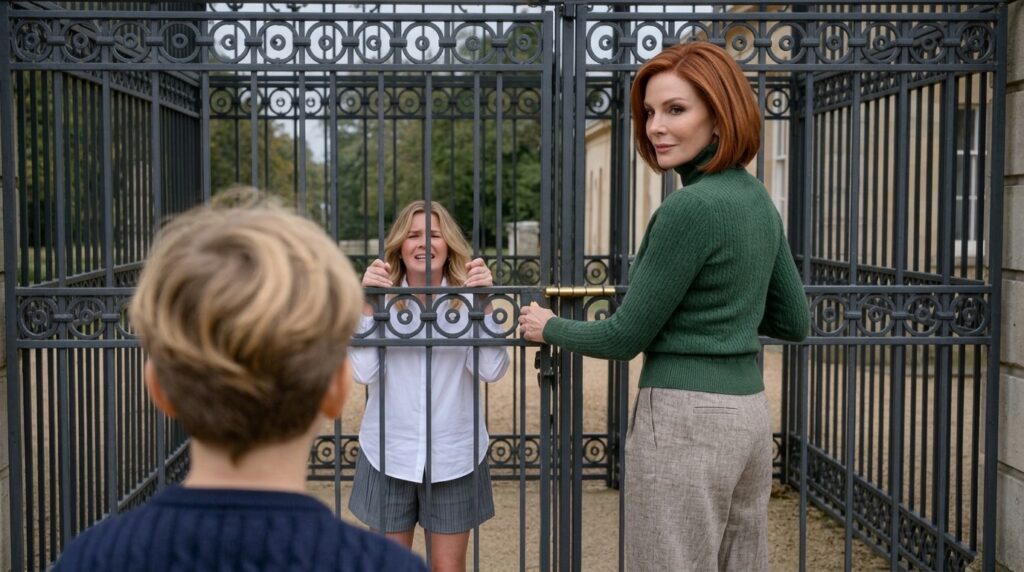
One second, Emily was stumbling backward across the cracked, dust-blown concrete of the rear patio, her sneakers scrabbling for traction as she fought to keep her balance; the next, the heavy, galvanized chain-link gate swung shut with a shuddering metallic clang, and she was staring through a crisscrossed diamond grid at her mother-in-law.
Diane stood on the outside of the enclosure, her posture straight, unhurried, and perfectly balanced in her bone-colored leather flats.
She wore a crisp ivory silk blouse, tailored navy trousers pressed with military sharpness, and an antique gold brooch pinned over her heart. Not a single silver strand of her sculpted bob was out of place. In her manicured right hand, she casually held Emily’s cracked smartphone; in her left, she held the miniature brass key to the Master Lock.
Her face was completely devoid of rage. It was worse than rage. It was the serene, bloodless indifference of a homeowner closing a pantry cabinet or sliding a deadbolt on an empty tool shed.
“Maybe a night out here will teach you who owns this house, Emily,” Diane said.
Her voice was level, conversational, carrying that smooth, patrician drawl reserved for reprimanding careless domestic staff. It was that terrifying absence of emotion that caused the hair on Emily’s arms to rise.
Behind Diane, the sun was hemorrhaging its last copper and violet rays against the dense line of loblolly pines fringing the property line. The late-autumn air was bleeding its warmth with frightening speed. Emily looked down at her own trembling frame: she was wearing nothing more substantial than a thin, heather-gray cotton sweater, faded denim jeans, and low-cut canvas shoes.
The enclosure was twenty feet long and six feet wide—an industrial dog run built from heavy steel pipe and diamond-mesh wire, originally erected to house Diane’s pair of aggressive German shepherds. The dogs were away at an upscale grooming retreat in Buckhead for the weekend, but their dominance lingered everywhere: the packed, hard-baked red clay beneath Emily’s shoes was stained dark with dried mud, scattered with dry pine needles, and reeked of damp canine fur and cedar shavings. Two massive stainless-steel water bowls sat tipped on their sides near the rear corner.
Emily took two rapid strides forward, her hands seizing the cold, zinc-coated steel wire:
“Open this gate, Diane! Right now! This is criminal restraint! You cannot lock a human being in a cage!”
She rattled the frame. The heavy hinges shrieked in protest, but the brass padlock held fast against the steel drop-latch.
Diane did not even blink. A microscopic, mocking smirk curled the edge of her coral-painted lips.
“You always were prone to theatrical outbursts, dear,” Diane murmured, slipping the brass key into the deep pocket of her slacks while tucking Emily’s phone inside her leather clutch. “No one is restraining you. You are simply taking a cooling-off period until you learn how to address the woman whose charity keeps a roof over your child’s head.”
Diane turned on her heel and strolled leisurely toward the rear French doors of the main house.
Emily watched the glass door slide shut. The heavy interior lock clicked.
Seconds later, the warm, amber glow of the kitchen chandelier flared to life, casting long, mocking rectangles of golden light across the flagstone patio. Through the sheer linen curtains, Emily could see Diane kettle-brewing tea, calmly rinsing a porcelain cup, completely unbothered by the human life she had discarded in the dirt.
Two weeks earlier, Emily had believed moving into this four-acre estate in Alpharetta would be an uncomfortable, but entirely manageable, sacrifice.
A catastrophic main-line pipe failure had flooded the modest two-bedroom garden apartment she shared with her husband, Ethan, and their twelve-year-old son, Noah. Black water had ruined the floors, soaked the drywall, and forced an emergency evacuation while remediation teams stripped the residence down to the concrete studs.
Ethan had been devastated. An overworked senior structural engineer at a premier regional infrastructure firm, he had been clocking fourteen-hour shifts preparing bids for a major high-speed rail corridor. He was already drowning in fatigue. When his mother offered her sprawling suburban guest suite, Ethan had taken Emily’s hands in the dark of their flooded living room, pleading with his eyes:
“Just three weeks, Em. Four at the absolute most until the insurance check clears and the new hardwood is down. I know she’s difficult. I know she has an edge. But we don’t have twenty-five hundred dollars a month for short-term corporate housing while saving for Noah’s prep school. Please. For me.”
Emily had swallowed her pride and agreed. She had told herself that love meant absorbing discomfort so her husband wouldn’t shatter under the weight of his professional obligations.
She had been profoundly, tragically wrong.
Diane had not viewed their temporary displacement as an act of maternal refuge. She had seized upon it as a long-awaited opportunity to systematically dismantle Emily’s dignity, one calculated humiliation at a time.
Every morning in that house was an orchestrated psychological ambush disguised as domestic instruction.
If Emily made coffee, Diane would inspect the grounds, sighing loudly about the waste of imported Columbian beans. If Emily folded the laundry, Diane would refold every single towel in front of her, remarking that “people raised in rental trailers never understand the proper grain of Egyptian cotton.” Emily parked her aging sedan two inches too close to the hydrangeas; Emily allowed the shower to run four minutes longer than necessary; Emily bought the store-brand whole milk instead of the organic glass bottles from the specialty co-op.
And behind every small correction was the unyielding, poisoned refrain that Diane delivered with venomous sweetness:
“You are living under my roof for free, Emily. The least you can do is learn your place.”
Emily had borne it all in silence. She had bitten her tongue until the inside of her cheeks were raw, sweeping floors that were already clean and washing dishes by hand before Ethan arrived home at nine at night, gray-faced and hollow-eyed from structural calculations. She had refused to burden him with his mother’s cruelty, desperate to prevent a domestic war between a son and the woman who raised him.
Then came three o’clock this afternoon.
Ethan had departed at dawn for an on-site bridge inspection in Savannah, leaving his phone on silent during high-elevation crane testing.
Diane had waited until Noah was at middle school before launching her masterstroke.
She had marched into the upstairs guest room without knocking, holding an open, midnight-blue velvet jewelry case. Her antique diamond tennis bracelet—an heirloom Diane claimed was appraised at forty-five thousand dollars—was missing from her master suite dressing table.
Emily had looked up from folding Noah’s school uniforms, baffled: “I haven’t been in your wing of the house since Tuesday, Diane. I haven’t seen your bracelet.”
Diane had closed the distance between them, her designer perfume suffocating in the small room.
“Things never sprouted legs and walked out of this house until you brought your baggage through my front door,” Diane had sneered, her voice dropping into a razor-sharp whisper. “Girls from your background don’t change their stripes, Emily. Your father died a bankrupt drunk, and your mother scrubbed hospital sheets on the night shift just to keep the repo men away from your porch. Thievery is in your blood.”
The mention of her parents had detonated the dam Emily had maintained for fourteen agonizing days.
“Do not ever speak of my parents,” Emily had said, standing straight, her eyes blazing into Diane’s for the very first time. “My father was an honest carpenter who died of leukemia, and my mother worked three jobs with clean hands. They had more honor in their fingernails than you have in your entire pedigree.”
Diane’s reaction had been instantaneous, vicious, and animalistic.
She had lunged forward, catching Emily’s wrist in an iron grip. When Emily wrenched her arm free, Diane’s right hand had whipped across the narrow space, striking Emily across the left cheekbone with the sickening, wet crack of bone against flesh.
The violence had staggered Emily, sending her crashing against the doorframe, her vision blacking out for two terrifying seconds.
Instinctively, sobbing with shock and humiliation, Emily had pulled her phone from her back pocket, gasping that she was calling the police and calling Ethan.
That was when the facade of the civilized Southern matriarch had completely vanished.
Diane had torn the device from Emily’s shaking fingers with shocking, frantic strength. She had seized Emily by the collar of her sweater, dragging her down the back staircase, shoving her violently through the mudroom, across the patio, and into the open run of the dog kennel.
Now, as the twilight deepened into a bruised, freezing indigo, Emily stood alone in the cage.
The temperature was dropping into the low forties. The wind off the northern ridges whistled through the pine needles, biting through her cotton sweater like needles of ice. Her cheek was swollen taut, throbbing in sync with the heavy, frantic pounding of her heart.
She grabbed the chain-link again, shaking it until the galvanized pipes groaned:
“Diane! Let me out! Noah will be home any minute! Do not let our child see this!”
Inside the house, the silhouette of Diane shifted behind the kitchen window. The woman raised a porcelain cup to her lips, paused, and let the sheer curtain fall back into place.
She was waiting for total capitulation. She wanted Emily crawling on her knees in the red dirt, begging for a coat, promising unconditional subservience before she turned the key.
Forty minutes crawled past in agonizing, shivering isolation.
Emily paced the narrow concrete strip, wrapping her arms around her ribs, stamping her feet to keep the blood flowing to her toes. Her breath puffed into white, ghostly clouds against the wire mesh.
Then, through the howling wind, came the familiar, crunching sound of tires turning onto the crushed-stone driveway out front.
A car door slammed.
Emily’s heart leaped into her throat. “Ethan…?”
She scrambled to the front of the kennel, pressing her face against the frigid wire.
It wasn’t Ethan’s heavy work truck.
It was the suburban carpool minivan.
Seconds later, twelve-year-old Noah rounded the brick corner of the garage, his backpack slung carelessly over his left shoulder, humming a video game theme under his breath.
He took three steps onto the patio flagstones.
And stopped dead.
Chapter 2 – The Red Light on the Screen
Noah’s face did not simply pale; every drop of youthful warmth evacuated his skin until he resembled a marble statue beneath the exterior security floodlights.
His hazel eyes—identical to Ethan’s—swept across the rear yard.
He saw the heavy brass padlock on the iron drop-latch.
He saw the red clay smeared across the hem of his mother’s jeans.
And then his gaze locked onto the dark, angry purple contusion spreading across the left side of Emily’s face.
“Mom…?” Noah whispered.
The word was so small, so fractured by raw, unadulterated horror, that it shredded what little composure Emily had left.
“Noah, baby, listen to me,” Emily gasped, her voice shaking violently from the biting cold, forcing herself to sound calm despite the tears streaming down her bruised cheek. “Do not come near the gate. Turn around right now. Walk down the driveway to Mrs. Gable’s house. Tell her to call your father’s direct line and call the county sheriff. Go, Noah! Run!”
Noah did not move an inch.
His backpack slipped from his fingers, hitting the patio flagstones with a dull, heavy thud.
The boy stood six inches taller than he had six months ago, having hit his adolescent growth spurt early, but in that moment, his posture completely shifted. The carefree, gentle twelve-year-old vanished.
His jaw locked. His shoulders squared with a rigid, frightening intensity that Emily had only ever seen on Ethan when an engineering foundation was on the verge of catastrophic failure.
“Grandma did this?” Noah asked.
His voice wasn’t tearful. It was a cold, flat monotone that chilled Emily deeper than the Georgia wind.
“Noah, please—”
CLICK.
The kitchen French door swung open with aggressive velocity.
Diane stepped out onto the patio, wrapping a heavy cashmere cream cardigan around her shoulders, wearing an expression of calculated, motherly authority:
“Noah, darling! Thank goodness you’re home from practice,” Diane said smoothly, extending a manicured hand toward the boy. “Come inside right this second. The wind is picking up and I baked cinnamon rolls. Your mother had a very unfortunate emotional episode and needs some quiet time to reflect on her behavior.”
Noah didn’t look at the house. He didn’t look at the open door.
He looked dead into his grandmother’s eyes.
“Why is my mom in the dog cage?” Noah asked.
Diane’s smile tightened, the honeyed veneer thinning into sharp, brittle impatience:
“I told you, Noah, adults have disagreements that children do not understand. Your mother took something that did not belong to her. She became hysterical and violent. Now pick up your schoolbag and get inside before I call your father.”
“Call him,” Noah said.
Diane blinked, caught off guard by the total lack of deference in the child’s tone. “Excuse me?”
“Call my dad,” Noah repeated, his voice cutting through the backyard like a scalpel. “Tell him you put my mom in a dog cage.”
Diane’s face darkened, the aristocratic mask slipping completely, replaced by an ugly, venomous sneer. She took three aggressive strides toward the boy, her hand reaching out to seize his arm:
“You disrespectful little whelp! You will not speak to your grandmother in that tone! Give me that bag and get into the house before I—”
Noah took half a step backward, smoothly evading her reach.
With practiced, deliberate speed, his right hand dipped into the open zippered pocket of his fleece jacket.
He pulled out a sleek, matte-black smartphone.
He did not dial a number. He simply held the device high, bracing his forearm, pointing the rear camera lenses directly at Diane’s face, then panning smoothly down to the padlock on the chain-link kennel where Emily stood trapped.
In the upper-right corner of the high-resolution screen, clearly visible in the bright glare of the floodlights, a tiny red dot was pulsing steadily.
Diane froze mid-stride, her manicured fingers suspended in the freezing air:
“What do you think you’re doing, Noah? Put that toy away this instant!”
Noah’s hand trembled slightly from adrenaline, but his gaze never wavered.
He looked at his grandmother with an ancient, terrifying clarity:
“Dad told me two weeks ago to set the cloud-sync to automatic,” Noah said, each syllable dropping like an anvil onto the stone.
“He told me to record everything you do when he’s away.”
Chapter 3 – The Headlights on the Magnolia Drive
The backyard plummeted into a vacuum of total, suffocating silence.
The wind rustled through the dying hydrangeas, but on the patio, not a single breath was drawn.
Diane’s eyes dilated until the whites encircled her pupils.
Her gaze darted from the pulsing red dot on the phone screen to the child’s stone-cold face, then toward the dark windows of the empty house.
The arithmetic of her situation began processing behind her eyes with terrifying speed:
“He… Ethan told you to do what?” Diane stammered, her voice cracking for the first time. “Ethan would never… I am his mother! I raised him! He built his career on my sacrifices!”
“Dad knows you broke the pipes in our apartment,” Noah said coldly.
Emily gasped from inside the kennel, her frozen fingers clutching the wire mesh so hard the metal bit into her skin:
“Noah… what did you say…?”
Noah kept the camera leveled at Diane:
“Dad hired an independent forensic plumber last Wednesday, Mom. The plumber found the wrench marks on the main valve beneath our subfloor. The water didn’t burst on its own. Dad found the transfer receipts from Grandma’s account to the maintenance technician.”
Diane lunged forward, her composure disintegrating into a feral, shrieking panic:
“Give me that phone, you little bastard! Give it to me right now!”
She threw her full weight toward the boy, her fingers clawing like talons toward the device.
ROAR.
The deafening, concussive rumble of a heavy-duty twin-turbo diesel engine shattered the neighborhood silence.
Two blinding halogen high-beams tore through the darkness of the driveway, illuminating the magnolia trees in stark, surgical white.
A heavy, dark-gray Ford F-350 dually did not merely pull up the driveway; it blew through the unlocked wooden side gate with a violent, splintering CRACK, the heavy timber fence posts snapping like dry toothpicks as the three-ton truck slid to an aggressive, gravel-spraying halt across the manicured grass of the back lawn.
Before the dust could settle, the driver’s side door was kicked open with concussive force.
Stepping out onto the grass was Ethan Carter.
He was not wearing his safety vest or his hard hat.
He was dressed in a dark flannel work shirt with the sleeves ripped to his elbows, heavy steel-toed work boots, his hands covered in hydraulic grease, his dark hair soaked with sweat and rain.
His eyes were bloodshot, sunken from seventy-two hours without sleep, but burning with an unholy, volcanic fury that made the Georgia night turn instantly to ice.
He didn’t look at his mother.
He didn’t look at Noah.
Ethan’s eyes locked straight onto the chain-link kennel—and onto the bruised, shivering woman locked inside.
Chapter 4 – The Sledgehammer from the Bed
Ethan did not speak a single word.
He turned toward the open bed of his commercial truck.
He reached into the steel tool-chest bolted behind the cab, his calloused hands wrapping around the fiberglass handle of a twenty-pound industrial demolition sledgehammer.
He hauled the steel weapon out with one fluid, terrifying movement, letting the heavy head drag across the patio flagstones with a shrieking, shower-throwing spark:
SCREEECH.
Diane backed up against the kitchen wall, her hands flying to her throat, her voice rising in a shrill, breathless wail:
“Ethan! Ethan, wait! Listen to me! Your wife attacked me! She stole my diamond bracelet! She went completely berserk and I had to protect myself until the police arrived—”
Ethan strode past her as if she were a ghost made of filthy smoke.
He reached the kennel gate.
He saw Emily’s purple, swollen cheek.
He saw her blue lips.
He saw her small, trembling body shivering violently in the dirt.
A sound tore from Ethan’s throat—a low, guttural, wounded roar that sounded more like a dying beast than a civil engineer.
“Ethan…” Emily wept, collapsing against the inside of the wire.
“Stand back, Em,” Ethan whispered. His voice was an iron slab dropping into a grave. “Move to the back corner. Cover your face.”
Emily scrambled to the rear of the enclosure, shielding her head with her arms.
Ethan stepped back, adjusted his boots in the gravel, raised the twenty-pound sledgehammer over his right shoulder with veins bulging like ropes along his neck, and brought the hardened steel face down onto the brass padlock with the full, hydraulic force of his six-foot-two frame.
BOOM.
The concussive crack echoed off the brick walls of the four-acre estate like a high-caliber gunshot.
The brass lock did not simply release; it shattered into three jagged chunks of flying metal. The heavy steel drop-latch sheered off its carriage bolts, spinning across the patio flagstones.
Ethan kicked the gate open with his boot.
The chain-link swung wide, shrieking on its hinges.
Ethan dropped the sledgehammer into the dirt, dropped to both knees in the mud, and gathered Emily into his massive, trembling arms.
He stripped off his heavy, fleece-lined canvas jacket with frantic haste, wrapping the thick, warm fabric around her shivering shoulders, pulling her body against his chest until her frozen face was buried in the hollow of his neck.
“I have you,” Ethan choked out, hot, heavy tears breaking from his eyes, splashing against her bruised temple. “I have you, Emily. I’m sorry. God forgive me, I am so sorry I let you stay in this house.”
Emily clutched the rough canvas of his coat, her entire body wracked with deep, agonizing sobs:
“Ethan… she took my phone… she slapped me… she told me I was garbage…”
“She is nothing,” Ethan whispered, his hand gently cupping the back of her head, rocking her in the red dirt. “She is less than nothing. And she is completely finished.”
Chapter 5 – The Blue Lights in the Cul-de-Sac
WHEEE-OOO-WHEEE-OOO.
The shrill, piercing wail of emergency sirens broke over the quiet suburban neighborhood.
Three patrol cruisers from the Fulton County Sheriff’s Department swept up the long driveway, their red and blue strobe lights painting the white columns of the mansion in violent, rhythmic slashes of emergency color.
Behind the marked cruisers drove a sleek, black administrative Lincoln Town Car bearing the gold insignia of the State Bar of Georgia.
Diane let out a ragged, triumphant gasp, smoothing her cashmere cardigan with shaking fingers:
“The police! Thank God Almighty! The police are here!”
She turned toward the deputies stepping onto the lawn with their hands resting on their sidearms:
“Deputies! Arrest him! My son has completely lost his mind! He destroyed my property with a sledgehammer! His wife is a thief who attacked me in my own hallway!”
The lead officer—a burly, gray-haired lieutenant named Miller—did not draw his weapon.
He didn’t even look at Diane.
He walked straight to the open passenger door of the Lincoln Town Car, holding the handle with crisp, formal deference.
Stepping onto the gravel was Arthur Kensington.
At seventy-four years old, Arthur Kensington was a legendary titan of the corporate bar, former Chief Justice of the Georgia Court of Appeals, and the senior managing trustee of the Carter Continental Engineering Consortium.
He was impeccably tailored in a bespoke charcoal three-piece suit cut from Savile Row wool, an antique gold pocket watch chain draped across his vest, his silver hair brushed back, his cold blue eyes carrying the terrifying, unshakeable authority of an apex courtroom predator.
In his leather-gloved hands, Kensington carried an eight-inch-thick, red-wax-sealed federal portfolio.
Arthur walked across the grass, stopping two paces from where Ethan was gently lifting Emily to her feet.
Arthur looked at Emily’s swollen cheekbone.
He looked at the shattered padlock lying in the mud.
He looked at the dog run.
The old judge’s jaw tightened until the muscles along his temples resembled granite ridges.
“Good evening, Ethan,” Arthur spoke, his voice a low, gravelly baritone that commanded the entire yard.
“Arthur,” Ethan replied, keeping his arm locked securely around Emily’s waist. “Are the dockets unsealed?”
“Certified by the Chief Judge of the Northern District of Georgia at five-fifteen this afternoon,” Arthur replied.
Diane marched forward, her heels clicking aggressively on the stone, her voice rising in shrill, indignant fury:
“Arthur Kensington?! What are you doing on my private property?! This is a domestic dispute between my son and his thieving wife! Get these police off my lawn before I call the County Commissioner!”
Arthur Kensington slowly turned his head.
His eyes were twin blades of arctic ice.
“Mrs. Diane Carter,” Arthur spoke, each syllable carrying the finality of a guillotine blade dropping in an empty courtyard.
“You do not have a lawn.”
Chapter 6 – The Unsealing of the Trust
Diane froze. Her mouth fell open in a grotesque, disoriented sneer:
“What… what did you just say to me?!”
Arthur unclasped the red-wax-sealed portfolio, withdrawing a heavy, blue-backed judicial decree stamped with the gold seal of the Supreme Court of Georgia:
“Exhibit Alpha,” Arthur announced, his voice rolling through the autumn night like approaching thunder.
“The master testamentary filings of the late David Carter, executed in November of twenty-eighteen.”
Arthur adjusted his gold-rimmed reading glasses with clinical, surgical cruelty:
“For twenty-two years, Diane, you have operated under the narcissistic delusion that this four-acre estate in Alpharetta was your personal kingdom.”
He tapped the certified parchment:
“When David discovered that you had liquidated sixty thousand dollars from Ethan’s college trust to cover private high-stakes gambling debts at the casino riverboats in Biloxi, he restructured every deed, every parcel, and every operating account into the Carter Family Irrevocable Sovereign Trust.”
Diane’s breath hitched in her windpipe.
The color drained from her cheeks in a sickening, concussive wave:
“No… David left this house to me! I am his widow!”
“You were granted a conditional life estate, Diane,” Arthur replied with razor-sharp legal precision.
“A revocable occupancy license governed strictly by Section Fourteen—the Familial Decorum and Moral Turpitude Covenant.”
Arthur looked at the two sheriff’s deputies standing beside him:
“Under the explicit terms established by David Carter:
If the occupant of this property ever engages in documented acts of physical battery, unlawful imprisonment, or malicious endangerment against Ethan Carter, his lawful spouse, or his direct lineage…”
Arthur leaned forward until his shadow completely blotted out Diane’s face:
“The life tenancy is Terminated Instantly and Permanently.”
He pointed to the open kennel:
“You didn’t just lock a daughter-in-law in a dog run, Diane. You executed your own unconditional eviction.”
Chapter 7 – The Bracelet in the Linen Closet
Diane staggered backward, her back hitting the brick exterior wall:
“That’s a lie! It’s a legal trick! Ethan forged those papers! She stole my diamond bracelet! I had every right to detain a felon on my property!”
Noah stepped forward from the patio.
He was still holding his phone, the camera recording every second.
“Lieutenant Miller,” Noah spoke clearly, his young voice carrying the unshakeable weight of an honest witness.
“Check the master bedroom linen closet. Top shelf. Inside the blue floral hatbox behind the spare duvet.”
Diane’s head whipped toward her grandson in pure, feral horror:
“Noah… you little spy! How dare you search my room?!”
Lieutenant Miller signaled to his sergeant. Two deputies pushed through the French doors into the house.
Two minutes later, the sergeant returned to the patio.
In his gloved hands, he carried a clear plastic evidence bag.
Inside the bag lay the sparkling, forty-five-thousand-dollar diamond tennis bracelet, wrapped in the original jeweler’s appraisal certificate.
“Found exactly where the young man said, Lieutenant,” the sergeant reported with cold professional disgust. “Tucked inside an envelope along with an insurance claims form dated yesterday morning.”
Lieutenant Miller looked at Diane, his weathered face hardening into pure contempt:
“You filed an insurance theft report forty-eight hours ago, Mrs. Carter. You were planning to collect the forty-five-thousand-dollar payout while framing your daughter-in-law for grand larceny.”
Diane collapsed against the brick wall, sliding down the masonry until she was sitting in the dirt of her own flowerbed, her manicured hands clawing at her pearls, hyperventilating in ragged, sniveling ruin:
“Ethan… baby… listen to your mother!” she wailed, tears smearing her expensive eyeliner across her foundation.
“I did it for you! That girl isn’t worthy of you! She comes from nothing! She has no pedigree! I wanted you to marry a woman from the country club! I wanted you to have an empire!”
Ethan looked down at the woman weeping in the dirt.
He didn’t yell.
He didn’t raise a fist.
The six-foot-two engineer stood tall, holding his bruised wife against his side, looking at his mother with an absolute, terrifying finality:
“Emily has more honor in her broken fingernails than you have had in sixty years of breathing, Mother,” Ethan whispered softly.
“And as of tonight… you don’t even have a name in this house.”
Chapter 8 – The Iron Cuffs in the Yard
CLICK-CLACK.
Lieutenant Miller and his sergeant stepped inside Diane’s space, unholstering two pairs of heavy, high-tensile steel handcuffs.
“Diane Carter,” Lieutenant Miller read from a certified warrant docket.
“You are under arrest for Felony False Imprisonment, Aggravated Assault, Criminal Deprivation of Civil Rights, Insurance Fraud Exceeding Forty Thousand Dollars, and Tampering with Evidence.”
“Don’t touch me!” Diane shrieked—a high, piercing animal wail of ruined suburban vanity as the deputies hauled her up from the dirt by her silk sleeves.
“I am a member of the Daughters of the American Revolution! My late husband built the municipal library! You cannot put me in a cage!”
“You seemed to think cages were perfectly acceptable ten minutes ago, ma’am,” Lieutenant Miller replied with icy sarcasm.
SNAP.
The steel irons ratcheted shut around Diane’s manicured wrists with a concussive, echoing crack that resonated across the entire cul-de-sac.
They dragged her across the flagstones, her bone-colored flats scuffing through the gravel, past the neighbors who had gathered along the wooden fence lines, whispering and filming on their phones in open revulsion.
She was shoved into the back of the patrol cruiser.
The heavy steel door slammed shut:
THUD.
The red and blue emergency lights flashed against the pines as the police convoy wound its way down the quarter-mile driveway, disappearing into the dark Georgia night.
The yard fell into an unshakeable, profound silence.
The house was clean.
Chapter 9 – The Recovery of the Sovereign Estate
Seventy-two hours later.
The crisp morning sun of early winter broke over the four-acre estate in Alpharetta, painting the rolling lawns, the towering magnolia trees, and the brick terraces in brilliant ribbons of gold, rose, and amber.
The dog kennel was gone.
A specialized industrial demolition crew hired by Ethan had cut the steel frame apart with oxyacetylene torches on Saturday morning, hauling every pipe, every piece of wire mesh, and every cubic foot of red clay away to a commercial recycling foundry.
In its place, landscape architects were laying rich, dark loam, planting a fifty-foot botanical conservatory filled with white climbing roses, hydrangeas, and winter jasmine.
Inside the grand sunlit kitchen, the old furniture had been cleared out.
Emily sat at the newly installed walnut breakfast island, wearing an oversized, comfortable cream cashmere sweater and soft linen trousers.
Her swollen cheek had been treated by top maxillofacial physicians in Atlanta; the bruising had faded to a faint, pale shadow beneath her clear hazel eyes.
Sitting beside her was Noah, happily eating a plate of freshly prepared buttermilk pancakes, his laptop open as he showed his mother a blueprint for his school robotics competition.
Ethan walked into the kitchen, carrying two steaming mugs of freshly ground dark-roast coffee.
He set a mug gently in front of Emily, leaning down to press a deep, lingering kiss against the crown of her hair:
“How does the coffee taste, Mrs. Carter?” Ethan murmured, a soft, radiant smile curving his lips—a smile that looked ten years younger, entirely free of the crushing tension that had haunted him for months.
Emily leaned into his chest, closing her eyes, feeling the steady, powerful rhythm of his heartbeat beneath her fingers:
“It tastes like peace, Ethan,” she whispered softly.
Arthur Kensington walked into the kitchen, carrying a slim, gold-embossed leather portfolio.
He bowed with deep, sacred reverence before Emily:
“Good morning, Madam Trustee.”
Emily blinked, smiling: “Arthur, please, you don’t have to call me that.”
Arthur set the heavy document on the island:
“Under the emergency probate decrees executed yesterday by the Superior Court:
The entire four-acre estate, along with David Carter’s twelve-million-dollar infrastructure patent portfolio, has been deeded exclusively, irrevocably, and perpetually to the Emily & Noah Carter Sovereign Living Trust.”
Arthur adjusted his spectacles with quiet, unyielding pride:
“Diane entered a formal guilty plea this morning to avoid a public jury trial. She received a sentence of Twenty-Two Years at the Pulaski State Correctional Facility, with a mandatory minimum of fifteen years before parole eligibility.”
Arthur looked at Noah, then at Emily:
“The estate is yours, Emily. No one can ever question your right to this roof again.”
Chapter 10 – The Sovereign Morning
One year later.
The early summer sun broke over the expansive green lawns of the restored Alpharetta estate, washing the white brick pillars, the blooming rose conservatory, and the calm waters of the new stone reflecting pool in dazzling ribbons of gold, rose, and sapphire.
The morning breeze was sweet with the scent of wild honeysuckle, sweet clover, and damp pine needles.
Down on the manicured lawn, thirteen-year-old Noah was kicking a soccer ball into a miniature goal, laughing with pure, bell-like joy as a golden retriever puppy chased him across the clover.
He was tall, strong, fearless, and completely unburdened by the shadows of the past.
Emily stood on the wide stone terrace wearing an open-collar white linen wrap dress, holding a warm cup of coffee, watching her son conquer the morning.
On the cedar mantel inside the sunlit gallery sat a framed photograph taken that very morning: Ethan, Emily, and Noah standing together in the sunlit conservatory, their smiles unbroken and radiant.
Ethan walked out onto the terrace, slipping his strong arms gently around Emily’s waist, pulling her back against his broad chest.
He buried his face into her dark hair, inhaling the clean scent of vanilla and morning air:
“Are you happy, Emily?” he murmured softly against her neck.
Emily leaned her head back against his shoulder, looking out across the vast, sunlit property that belonged to their family:
“I am whole, Ethan,” she whispered, turning her face up to meet his lips in a slow, sacred, sovereign kiss.
“We are finally home.”
The brass padlock was melted to slag.
The cruel mother-in-law was locked behind state iron bars.
The boy who stood with his camera had delivered his mother into the light.
And standing together on the high stone terrace beneath the vast, unbroken Georgia sky, the engineer, his sovereign queen, and their brave son looked toward the rising sun—unbroken, triumphant, and forever free.





