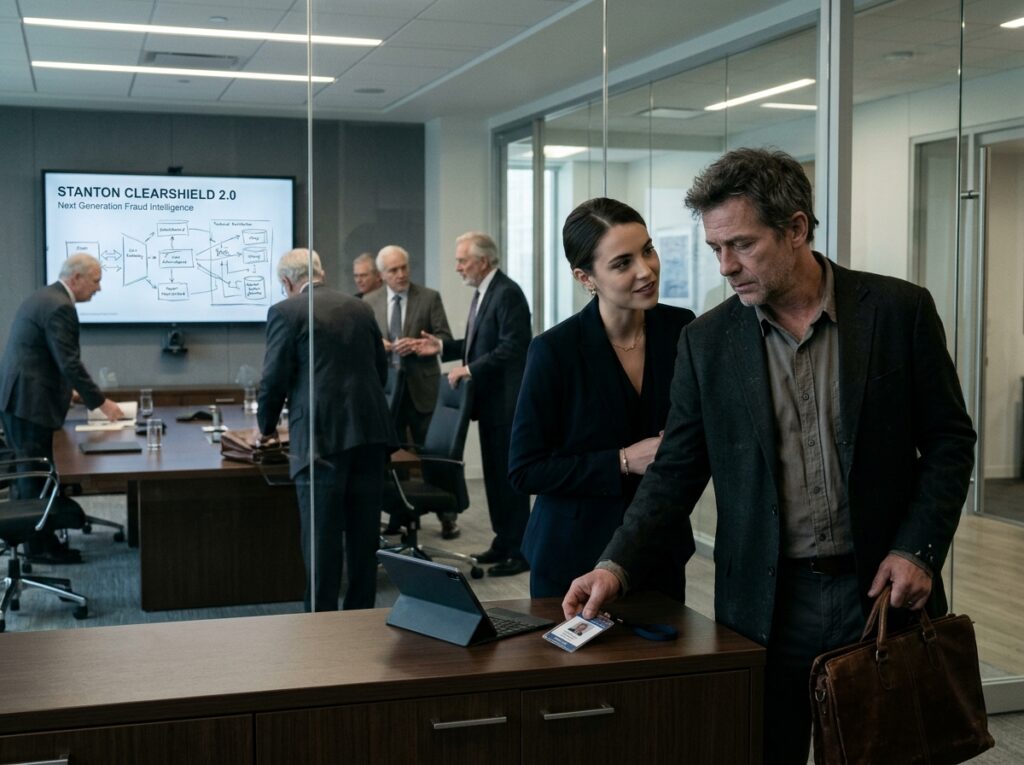
“We’re going with my plan instead.”
Amber Stanton said it without looking at me, as though interrupting a seventy-million-dollar investor presentation were no different from changing the lunch reservation.
I had been speaking for nineteen minutes. The five partners from Great Lakes Capital Partners were following my presentation closely, and Jonathan Fairfax, their managing partner, had already written several notes on the draft term sheet in front of him.
For the first time in months, I felt that four years of work might finally be getting the recognition it deserved.
Then the glass doors opened.
Amber walked into the forty-second-floor boardroom at Torrance Analytics Group wearing an oyster-gray blazer and carrying a tablet. She was twenty-four, the company’s chief innovation officer, and the youngest daughter of our CEO, Richard Stanton.
She had never designed a fraud detection system. She had, however, spent most of her life watching her father persuade people to give him money.
“I apologize for interrupting,” she said.
She sounded about as apologetic as someone arriving early to claim a reserved table.
“I’ve been reviewing our technical roadmap, and I think we owe our investors a more ambitious proposal.”
I turned toward Richard.
He was seated at the far end of the brushed-steel conference table, his hands folded comfortably in front of him. I expected him to tell Amber that we could discuss her ideas after the technical presentation.
Instead, he leaned back.
“Go ahead, sweetheart.”
I had worked with Richard long enough to recognize that expression. He wasn’t surprised. He was pleased.
Amber connected her tablet to the presentation system.
My regression heat map, which represented four years of behavioral analysis across sixty-three Canadian financial institutions, disappeared into a small window in the corner.
A different presentation filled the screen.
Stanton ClearShield 2.0: Next Generation Fraud Intelligence.
Underneath the title were three words.
Architect: Amber Stanton.
I stopped breathing normally when she reached the third slide.
The diagrams were mine.
Not just similar to mine. They were copies of preliminary architecture sketches from a private notebook I kept in my office. I recognized a particular arrangement of processing layers, including a notation I had written months earlier while trying to solve a difficult calibration problem.
Those were unfinished drawings.
They weren’t supposed to be presented to anyone, much less prospective investors.
Amber began explaining the diagrams with polished confidence.
She spoke about competitive differentiation, market share, scalable intelligence, and the future of automated fraud detection. Her language was impressive if you didn’t know what the drawings actually represented.
Jonathan Fairfax nodded.
One of his colleagues wrote something in his notebook.
I stood beside the conference display with a laser pointer in my hand, trying to decide whether to interrupt.
What would I say?
That the CEO’s daughter was presenting my work?
That the drawings had come from a notebook she had no reason to possess?
That the technical architecture she was promising didn’t actually work in the form she was showing?
Richard was watching his daughter with an expression of unmistakable pride.
I had spent four years trying to earn that expression from him.
When Amber finished, the room broke into applause.
Jonathan Fairfax stood.
“This is exactly the kind of strategic vision we’ve been looking for,” he said. “Ambitious, commercially focused, and positioned for growth. Excellent presentation, Amber.”
Richard rose to embrace his daughter.
The other investors continued applauding.
Nobody asked me a question.
Nobody even seemed to remember that I had been presenting.
I placed the laser pointer on the table.
I disconnected my laptop, slipped it into my briefcase, and removed my access badge from its lanyard.
Amber approached while her father was occupied with the investors.
“We won’t be needing your technical guidance anymore, Michael,” she said quietly.
Her smile was small and satisfied.
“You’ve been very helpful.”
For a moment, I looked at her and wondered whether she had any idea what she’d just done.
Then I looked past her at Richard.
He was laughing at something Jonathan had said.
I laid my badge on the credenza beside Amber’s tablet, picked up my briefcase, and walked out.
I smiled as I passed through the glass doors.
It wasn’t because I felt triumphant.
I was fifty-three years old, and after twenty-eight years in my profession, I had just watched a young woman take credit for my work while the man who had promised to protect my position applauded her.
I didn’t trust myself to say anything useful.
The elevator took forty seconds to reach the lobby.
I remember because I watched the numbers change above the doors while the boardroom replayed in my head.
At street level, the lunchtime crowd was moving through Brookfield Place. People crossed the marble concourse carrying coffee, checking phones, and discussing meetings. I passed through the atrium and stepped into the October cold on Wellington Street.
The city looked exactly as it had that morning.
That annoyed me more than it should have.
I went down to the parking garage, got into my car, and sat without starting the engine.
My dashboard clock read 11:14.
The formal technical audit was scheduled for Thursday at ten.
Less than forty-eight hours away.
I stared at the concrete support column in front of my windshield and thought about how thoroughly I had misjudged Richard Stanton.
I first met Richard in Montreal in 2020.
I was presenting a paper at a fintech conference about adaptive machine-learning systems and behavioral fraud detection. My presentation wasn’t particularly glamorous. It was full of probability models, classification errors, transaction volumes, and the limitations of traditional rules-based fraud detection.
Richard approached me afterward.
He was charming, direct, and clearly worried.
Torrance Analytics Group had once been a promising financial technology company, but its platform was aging. Major banks were beginning to demand capabilities his systems couldn’t deliver. Two important contracts were approaching renewal, and his engineering team was struggling to keep pace with newer competitors.
He wanted someone who could rebuild the technology without abandoning the clients who depended on it.
“You seem like a man who knows the difference between something that works in a presentation and something that works in a bank,” he told me.
I appreciated that distinction.
It was one I had built my career around.
I grew up in Hamilton, Ontario, the second son of a steelworker and a nurse’s aide. My parents didn’t have much money, and our household operated on the understanding that carelessness was expensive.
I paid close attention in school, applied for scholarships, and worked my way through an engineering degree at the University of Waterloo. Later, I earned a master’s degree from Queen’s University.
By the time Richard recruited me, I had spent nearly three decades building fraud detection infrastructure for financial institutions across North America.
I wasn’t looking for a prestigious title.
I wanted the opportunity to build something properly.
Richard offered me a senior technical position, substantial equity, and authority over the technical direction of the company.
He understood that the platform needed to be rebuilt rather than endlessly patched.
Or at least I believed he understood.
Over the following four years, I helped turn ClearShield from an outdated rules engine into a behavioral intelligence platform capable of identifying unusual transaction patterns without constantly disrupting legitimate customers.
The underlying problem was more complicated than most people outside the industry appreciated.
A conventional fraud detection system could flag suspicious behavior by applying fixed rules. But customers didn’t behave identically. A transaction that was ordinary for one account holder might be highly unusual for another.
If the system was too sensitive, innocent customers found their purchases blocked. Banks faced unnecessary investigations and overwhelmed review teams.
If the system was too permissive, important warning signs could be missed.
Finding the right balance wasn’t a one-time adjustment.
It required a model that could interpret behavior differently across institutions, account types, and changing transaction patterns.
That was where most of my work went.
I spent mornings studying overnight processing results, afternoons reviewing architecture decisions with engineers, and evenings comparing accuracy figures against real transaction patterns.
There were days when the most important thing I accomplished was preventing someone from making a seemingly harmless adjustment that would produce thousands of incorrect classifications at scale.
My lead systems architect, Lynn Novak, understood those days.
She was intelligent, methodical, and sufficiently confident in her own judgment to challenge mine when she thought I was wrong.
We worked well together because neither of us treated disagreement as an insult.
Sometimes she would arrive at my desk with a set of results that contradicted our assumptions. We’d spend an hour identifying the problem, then another two determining whether the problem was in the data, the model, or our interpretation.
It wasn’t dramatic work.
But it mattered.
By the previous spring, our live pilot with three Canadian chartered banks had achieved a false positive rate of 0.3 percent.
The figure was so promising that auditors asked us to verify the testing methodology.
We did.
The results held.
For the first time, Torrance had technology that could credibly compete for much larger institutional contracts.
That progress formed the foundation of the seventy-million-dollar investment opportunity with Great Lakes Capital Partners.
It also made Amber Stanton interested in what we were doing.
Amber had joined Torrance eighteen months earlier after completing an MBA in London.
Richard created the chief innovation officer position for her.
She received an office on the thirty-eighth floor, a generous budget, and the freedom to attend meetings across departments.
I had nothing against her involvement initially.
Companies need people who understand markets, customers, and strategic positioning. Good engineering doesn’t automatically translate into a successful business.
When Amber came to technical meetings, I answered her questions.
Sometimes she asked thoughtful ones.
Other times she seemed more interested in how a result could be presented than in what the result actually meant.
That wasn’t necessarily unusual for someone working in strategy.
The trouble began when she stopped distinguishing between understanding the work and owning it.
Six months before the investor presentation, Amber delivered a quarterly board update involving our Calgary Credit Union pilot.
She presented the results as the outcome of her strategic initiative.
My engineering team had conducted the testing, developed the architecture, investigated the problems, and verified the results.
Amber had attended meetings about the project.
I waited until the presentation ended before approaching Richard.
“Can we talk privately?”
He invited me into his office.
I explained that I had no objection to Amber discussing the commercial potential of our technology. But presenting the pilot as something she had initiated and directed was inaccurate.
Richard listened with the patient expression he sometimes adopted when he had already decided not to do anything.
“She’s learning the business, Michael.”
“I understand that.”
“Then help her learn. She’s enthusiastic.”
“Richard, I’m not asking you to discourage her. I’m asking you to make sure our work is represented correctly.”
He smiled.
“You should see her involvement as an asset, not a threat.”
I remember how tired that answer made me.
It suggested that my concern was personal insecurity rather than professional accuracy.
I had spent decades sharing credit with colleagues. I had no need to be the only person associated with a successful project.
But there was a difference between sharing credit and allowing someone to claim work they hadn’t performed.
I left his office disappointed.
The following morning, I contacted Claire Desroches, an intellectual property attorney on King Street West.
Claire had advised me on patent matters during my earlier career, and I trusted her to tell me things I didn’t necessarily want to hear.
We reviewed my employment agreement carefully.
I explained the company’s architecture, my development responsibilities, and an independently developed calibration algorithm I had been working on during evenings and weekends in my home office in Oakville.
That algorithm was the Tanner Adaptive Waiting Layer.
It was designed to adjust how the detection model balanced sensitivity and false positives under changing transaction loads.
I had developed it through Tanner Systems Consulting, Inc., using my personal equipment and funds.
My private notebooks documented the work. The development records were separate from Torrance’s corporate repositories, and I had filed an early patent application with the Canadian Intellectual Property Office before Amber joined the company.
Claire examined the dates, agreements, documentation, and circumstances surrounding the work.
“Ownership is going to depend on the facts and the contract,” she told me. “The company may argue that work related to its business belongs to it, even if you developed part of it at home. We need to be precise about what you created independently.”
I appreciated that she didn’t offer an easy answer.
We spent considerable time establishing the distinction between the base detection platform developed for Torrance and the separate calibration work maintained by Tanner Systems Consulting.
The records mattered because the distinction wasn’t merely theoretical.
The base detection model on Torrance’s network could perform adequately in controlled testing. Under substantial real-world transaction loads, however, its sensitivity became unstable.
Without the adaptive weighting layer, its false positive rate could climb dramatically.
During stress testing, it had flagged nearly one in three legitimate transactions.
The calibration layer addressed that instability.
I had never uploaded that independently maintained component to Torrance’s servers or formally incorporated it into the company’s production codebase.
The successful demonstration environment used for our earlier pilot had included the properly calibrated working system. The corporate base model alone could not reproduce those results.
This was a serious technical dependency, and I knew the distinction would eventually have to be resolved formally if Torrance intended to deploy the technology at scale.
I also knew Richard had promised me technical autonomy and an equity arrangement that had become increasingly difficult to discuss with him.
After the board incident involving Amber, I stopped assuming those problems would resolve themselves.
Claire advised me to preserve every relevant record and avoid changing anything on the company’s systems without authorization.
I followed that advice.
Three weeks before the Great Lakes presentation, I noticed something unusual in my office.
A private notebook had been moved.
It was a small thing. The notebook usually sat to the left of my desk, tucked beneath other papers. I knew where I’d left it because I was particular about keeping current work separate from older drafts.
That afternoon, I found it in a different position.
At first, I wondered whether I had moved it without remembering.
Then I noticed that some pages were no longer aligned the way I’d left them.
I didn’t confront anyone.
I installed a small motion-activated camera inside a desk organizer on my bookshelf, positioned toward my work area.
Over the following two weeks, the footage recorded Amber entering my office four times after nine at night.
She used a master access card.
The recordings showed her photographing pages from my private notebook and copying material from my personal project folder onto a USB drive.
I watched the footage more than once.
I wanted there to be an innocent explanation.
Perhaps she had been told to collect something. Perhaps she believed the materials were available to her as chief innovation officer.
But she hadn’t asked me.
She hadn’t told me.
And the material she photographed included preliminary drawings I had deliberately kept separate from the final calibration work.
I preserved the recordings and discussed them with Claire.
We secured copies of the evidence and documented what had happened.
I didn’t go to Richard immediately.
His response to the Calgary presentation was still fresh in my mind, and I no longer trusted that he would take my concerns seriously.
I had hoped to complete the investor presentation and address the ownership and access issues through counsel afterward.
Instead, his daughter walked into the boardroom and put those private drawings on a screen in front of five potential investors.
Sitting in my car that Tuesday morning, I understood just how much Richard’s silence had cost me.
I didn’t mean the investment.
I meant the relationship.
Four years earlier, he had approached me as a partner in rebuilding something important.
Now he had watched his daughter claim my research and had treated it like a family achievement.
I started the engine.
The drive home to Oakville gave me plenty of time to reconsider leaving my badge behind.
I didn’t regret refusing to participate in the presentation.
I did regret that it had reached the point where walking away felt like the only honest response I could give.
When I reached home, I called Claire.
“She presented the unfinished architecture,” I told her.
Claire was quiet for a moment.
“The drawings from your notebook?”
“Yes.”
“And Richard?”
“He sat there and let her.”
I described the presentation, the applause, Amber’s comment, and my departure.
“Did you formally resign?”
“Not yet. I left my badge.”
“Then put your position in writing. We need a clear record of what you’re doing and why.”
“I’ll send it tonight.”
“And don’t touch the company systems.”
“I haven’t.”
“Good.”
I sat at the kitchen table after the call, looking at my laptop.
I had spent years solving other people’s technical problems before they became emergencies. It was almost instinctive to imagine what my team would be facing without me.
Lynn would probably be asked to prepare Amber’s architecture for Thursday’s audit.
She would do her best. So would the other engineers.
They were competent people.
But they had not been given the full calibration component.
Amber had taken unfinished diagrams and presented them as a complete design.
I didn’t know what Richard had told the investors about my departure. I didn’t know whether anyone had noticed the badge on the credenza.
I knew only that the Great Lakes auditors would expect the technology Amber had promised.
That evening, I prepared my written resignation and reviewed it with Claire.
I made no attempt to disable access, alter files, or remove code.
Everything I had developed on company time using company resources remained on Torrance’s network.
The independently developed waiting layer remained under the control of Tanner Systems Consulting.
On Wednesday morning, Richard issued a company-wide directive.
The technical team was to prepare a live demonstration environment for Thursday’s audit.
According to Lynn, Amber delivered copies of her architecture diagrams and instructed the engineers to configure the platform accordingly.
By noon, Lynn sent me an encrypted message.
They had run ten thousand simulated transactions through the model.
The system had flagged thirty-two hundred as suspicious.
I read the figure twice.
Thirty-two percent.
It was consistent with the behavior I had seen in the uncalibrated base model.
Amber ordered the engineers to adjust the sensitivity thresholds.
The results became worse.
Lynn’s next message was shorter.
She’s telling us to keep trying configurations.
I wanted to call her.
I wanted to explain exactly why changing the thresholds wouldn’t solve the underlying problem.
But I was no longer an employee responsible for implementing Torrance’s technical direction. I had resigned, and the company had already made its position on my guidance unmistakably clear.
I also didn’t want Lynn placed in the middle of a dispute between me and Richard.
I wrote back to tell her not to take unnecessary risks and to document her work accurately.
Then I put my phone down.
For the rest of the afternoon, I tried to concentrate on ordinary tasks at home.
I made coffee. I reviewed documents with Claire. I checked the records relating to the patent application and the development logs.
Every so often, I thought of the engineers in that building.
They hadn’t chosen this situation.
Most of them had trusted me for years, and I knew how frustrating it was to be ordered to make a system behave in a way its architecture couldn’t support.
By Wednesday evening, Lynn reported that the team had tested six configurations.
None had produced acceptable results.
At two in the morning, another message arrived.
Amber was in the server room, personally overseeing the engineers and demanding they rebuild the configuration from scratch.
Richard had called the head of infrastructure twice.
Nobody was getting much sleep.
I lay awake longer than I wanted to admit.
I was angry with Richard and Amber, but anger didn’t erase my concern for the people still working there.
Torrance employed 140 people.
Some had families and mortgages. Some had only recently joined the company. Many had no idea that the architecture being presented to investors had been assembled from incomplete material.
I didn’t want the company to fail.
I wanted its leadership to stop pretending that engineering decisions could be made through family loyalty and presentation slides.
Thursday morning arrived cold and bright.
At ten o’clock, Jonathan Fairfax entered Torrance’s demonstration suite on the forty-first floor with four investment partners and three independent technical auditors from a verification firm in Mississauga.
Lynn later described the scene in careful detail.
Amber stood beside the main dashboard in a charcoal blazer.
Richard was seated with the investors.
The engineers had managed to prepare a demonstration environment, and Amber began with a clean synthetic data set.
For the first several minutes, the results looked acceptable.
Low transaction volumes passed through the model without producing obvious problems.
Amber narrated the process confidently.
Jonathan Fairfax asked a few questions.
An auditor checked the reported accuracy figures against the documentation.
Then the lead auditor requested a stress test.
He wanted fifty thousand randomized transactions from the verification firm’s independent data set processed through the system.
Amber agreed.
The engineers initiated the test.
Within moments, the false positive rate began rising.
It crossed twelve percent.
One auditor asked to see the output logs.
The rate reached twenty-seven percent.
Another auditor stood and approached the testing console.
By the time the figure reached thirty-one percent, the lead auditor had stopped taking notes.
“Ms. Stanton, your documentation indicates a false positive rate below one percent at substantially higher volumes,” he said.
Amber glanced toward the engineering team.
“We may have a configuration issue with the testing environment.”
“The data set is correctly configured,” Lynn said from the back of the room. “I checked it this morning.”
Amber tried a different explanation.
“There could be server latency affecting the results.”
The auditor examined the logs.
“This isn’t latency,” he said. “The deployed model doesn’t appear to have a functioning adaptive weighting layer. The calibration parameters don’t match your technical documentation.”
He pointed to the screen.
“The architecture you’re demonstrating is incomplete.”
Richard sat forward.
Amber looked toward him.
For the first time, the room was asking questions that couldn’t be answered by a better presentation.
Jonathan Fairfax closed the folder in front of him.
“Richard, where is Michael Tanner?”
Richard hesitated.
“Michael has taken some personal time.”
Jonathan looked at the test results again.
“We’re discussing seventy million dollars. We were told this platform had been validated in independent trials with a false positive rate below one percent.”
He tapped the report.
“This system is returning thirty-one percent on a controlled stress test.”
Richard began explaining that the engineering team would investigate.
Jonathan interrupted him.
“Was Dr. Tanner involved in preparing this demonstration?”
Richard didn’t answer directly.
The silence was enough.
Jonathan stood and gathered his papers.
“We need a proper explanation of what we’ve just seen. I want Michael Tanner present, and I want the technical discrepancies addressed.”
He looked around at his partners.
“We’re finished for today.”
Before leaving, he gave Richard forty-eight hours to provide a credible explanation or Great Lakes would withdraw its proposed investment and consider referring its concerns to the appropriate authorities.
The partners followed him out.
According to Lynn, Richard remained in the demonstration suite after the doors closed.
Then he threw a glass of water against the wall.
I wasn’t there to see it.
I was in my home office in Oakville, reviewing documents with Claire.
She had arrived earlier so we could discuss the status of my resignation, the intellectual property records, and any response the company might make.
At approximately one-thirty, the doorbell rang.
I looked through the side window.
Richard Stanton stood on my front porch.
His tie was loose, and his usually immaculate silver hair looked as though he had been running his hands through it for hours.
Beside him stood Graham Osgood, Torrance’s chief financial officer.
Graham was holding a leather portfolio against his chest.
I knew him as a cautious man. During our years working together, he had rarely spoken without checking his figures first.
Seeing both of them on my porch told me the problem had moved well beyond Amber’s presentation.
I opened the door but left the security chain in place.
“Michael,” Richard said.
“Hello, Richard.”
“We need to talk.”
“If this concerns outstanding compensation or my resignation, Claire Desroches is representing me.”
I began giving him her contact information.
“Please,” he interrupted. “Can we just talk for a minute?”
I looked at him through the narrow opening.
He seemed older than he had on Tuesday.
“I’m listening.”
“There was a terrible misunderstanding at the investor presentation.”
I said nothing.
“Amber is young. She’s ambitious. She overstepped, and I should have handled it differently.”
“Differently?”
Richard looked toward Graham, then back at me.
“I should have made it clear that the platform was built on your work. I should have acknowledged your contribution in front of the investors.”
I waited.
He seemed uncomfortable with the silence.
“What happened Tuesday was wrong, Michael.”
It was the first time I had heard him say that.
Four years of working together, six months of increasing tension, a private complaint about Amber claiming my pilot results, and now an investor audit had failed.
Only then did Richard find the words.
Graham stepped forward.
“Michael, I need you to understand the financial position we’re in.”
He opened his portfolio but didn’t remove anything.
“We have thirty-six million dollars in outstanding bridge financing tied to this round. If Great Lakes walks away, we could breach our financing covenants before the end of November.”
I knew the investment was important.
I hadn’t known the bridge financing exposure was that large.
Graham continued.
“We have a hundred and forty employees. Most of them had nothing to do with what happened Tuesday.”
“I know that.”
“Then you understand why we’re here.”
I looked past them toward the quiet street.
Richard had once walked into a conference room in Montreal and offered me the chance to rebuild a company.
Now he was standing on my porch asking me to rescue the investment that his daughter had tried to claim.
“What exactly do you need?” I asked.
Richard answered immediately.
“We need you back in the building. Today.”
“To do what?”
“Resolve the calibration issue. Explain the discrepancy to Great Lakes. Get the platform running the way it did during the pilots.”
I considered his words.
“Amber told me Tuesday that you wouldn’t need my technical guidance anymore.”
Richard looked uncomfortable.
“She shouldn’t have said that.”
“She said it after presenting diagrams from my private notebook.”
His expression changed.
Graham glanced at him.
I continued.
“The architecture she showed the investors was preliminary. It wasn’t a finished system.”
“We know that now,” Richard said.
“Do you?”
He seemed offended by the question, then thought better of objecting.
“The waiting layer,” he said. “It isn’t on our servers.”
“No.”
“Did you remove it?”
I felt the familiar irritation of hearing a serious technical matter reduced to an accusation.
“I didn’t remove anything. Every piece of company work is exactly where I left it.”
“Then where is it?”
“The Tanner Adaptive Waiting Layer was developed independently through Tanner Systems Consulting. It was never uploaded to Torrance’s corporate repository.”
Graham looked down at his portfolio.
Richard rubbed his forehead.
“But the pilot worked.”
“Yes.”
“And we showed those results to investors.”
“Yes.”
“Then we need that technology.”
“I’ve been trying to explain the difference between the base platform and the calibration component for some time.”
Richard looked toward the driveway.
For several seconds, nobody spoke.
Then he turned back.
“Name your price.”
I had expected an argument.
I hadn’t expected him to move so quickly from apology to negotiation.
“Four hundred thousand a year,” he said. “Vice president title. Ten percent equity at closing, vested immediately.”
He looked directly at me.
“And Amber will have no further technical oversight. I’ll make that change personally.”
Graham stood beside him, silent.
I thought of the equity Richard had promised when he recruited me.
Fifteen percent.
Technical sovereignty.
A genuine partnership.
Those terms had mattered because they reflected what I believed we were building together.
Now Richard was offering me a smaller ownership stake and a larger salary after allowing his daughter to take credit for my work.
The new offer might have sounded generous to someone who didn’t know the history.
To me, it sounded like an attempt to purchase an emergency repair.
“Richard,” I said, “you promised me equity and control over the technical direction four years ago.”
“I know.”
“When Amber claimed my pilot results six months ago, I came to you privately.”
“I remember.”
“You told me I should see her involvement as an asset.”
He lowered his eyes.
“Tuesday, you watched her interrupt a seventy-million-dollar presentation, use material from my private notebook, and tell me I was no longer needed.”
“Michael—”
“You didn’t say a word.”
Richard looked exhausted.
“I handled it badly.”
“You let her represent work she hadn’t done as her own.”
“I know.”
“And now that the demonstration has failed, you’re offering to give me some of the authority I was supposed to have all along.”
He didn’t answer.
For a moment, I felt something close to grief.
I had genuinely liked Richard once.
He could be generous, funny, and energetic. In the early days, he had listened to my technical concerns and trusted me to make difficult decisions.
I had watched him build relationships with clients and negotiate opportunities our engineering team could never have secured alone.
We had needed each other’s expertise.
That was what made his behavior so disappointing.
He hadn’t simply favored his daughter.
He had allowed his affection for her to distort decisions that affected an entire company.
Behind me, Claire stepped into the hallway.
“Mr. Stanton,” she said, “I’m Claire Desroches. I represent Michael Tanner and Tanner Systems Consulting.”
Richard looked past my shoulder.
“Claire, perhaps you can help us find a reasonable solution.”
“Any proposal should come through counsel,” she replied. “And before we discuss licensing or employment terms, we need to address the intellectual property concerns.”
She explained that my independent development records, patent filing documentation, and supporting materials had been preserved.
She also informed them that we had footage showing unauthorized access to my private office and the copying of material from my notebooks and project folder.
Richard stared at her.
“What footage?”
“Four recorded occasions,” Claire said. “The materials are secured. We are prepared to address any unauthorized use through the appropriate legal channels.”
Graham shifted his portfolio from one hand to the other.
Richard looked at me.
“You recorded Amber?”
“I recorded activity in my office after discovering my private notebook had been disturbed.”
He seemed about to argue, but Claire continued before he could.
“Michael has not removed or disabled company technology. The dispute concerns independently developed intellectual property and its unauthorized use or representation. We intend to protect his interests.”
She paused.
“Any allegations against my client will be evaluated in light of the records we have preserved. We will also consider appropriate complaints regarding investor disclosures if the circumstances warrant them.”
Richard was quiet for a long time.
The cold air was entering the hallway through the narrow opening.
I could see Graham becoming increasingly uncomfortable.
Finally, Richard looked at me.
“You’re making a mistake.”
It didn’t sound threatening.
It sounded like something he needed to believe.
“I’m not coming back under these circumstances,” I said.
He nodded slightly.
Then he looked past me toward Claire.
“Will you at least discuss a licensing arrangement?”
“Submit a proposal through my office,” she answered.
Richard studied me one last time.
“I’m sorry, Michael.”
I wanted to believe he meant it.
Perhaps he did.
But meaning it now didn’t change what had happened.
“Goodbye, Richard.”
I closed the door.
For a while, I remained in the hallway.
Claire waited without speaking.
Eventually, I returned to the kitchen.
I felt relieved that the conversation was over, but I was also troubled by Graham’s description of the company’s finances.
A failed investment round could affect employees who had worked hard and acted professionally.
Lynn was still there.
So were engineers I had mentored, people who had spent years keeping clients satisfied and systems running.
It would have been easier emotionally if Torrance had consisted only of Richard and Amber.
It didn’t.
Claire joined me at the table.
“You all right?”
“I don’t know.”
She nodded.
“I expected him to be angry,” I said. “I didn’t expect him to offer me a job.”
“He needs something you control.”
“I know.”
“That doesn’t mean you have to accept an arrangement you no longer trust.”
I looked toward the window.
The street was quiet again.
For years, I had allowed my professional identity to become inseparable from Torrance.
The company’s successes had felt like mine, and its problems had followed me home.
Now I was sitting in my own kitchen wondering what would happen to people I cared about because I had finally refused to keep absorbing the consequences of Richard’s decisions.
At three-fifteen that afternoon, my phone rang.
Jonathan Fairfax.
I answered.
“Dr. Tanner?”
“Jonathan.”
“I hope I’m not calling at a bad time.”
“Not at all.”
He dispensed with the usual pleasantries.
“I need to understand whether the technology we saw during the original due diligence process is real.”
I appreciated that he asked directly.
“It is.”
“Because what we witnessed this morning doesn’t support the performance figures in your documentation.”
“I understand.”
“Then help me reconcile the difference.”
I explained that the base model demonstrated at Torrance was incomplete.
The successful pilot system used a separate adaptive calibration component I had developed independently.
Without that layer, the model produced excessive false positives under substantial transaction loads.
Jonathan listened without interrupting.
When I finished, he asked, “Are you saying Torrance doesn’t control the complete technology?”
“I’m saying the adaptive calibration layer is controlled by Tanner Systems Consulting. The ownership and licensing issues need to be handled formally.”
“Can you prove the performance figures?”
“Yes.”
“With independent verification?”
“Yes.”
There was a brief pause.
“How soon?”
“I can be in your boardroom in ninety minutes.”
“Bring what you need. I’ll assemble the auditors.”
I ended the call and looked at Claire.
She had heard enough to understand.
“Jonathan?” she asked.
“Yes.”
“What does he want?”
“A demonstration.”
She considered that.
“Then we’ll make sure everyone understands exactly what they’re being shown and who controls it.”
I gathered my laptop, prepared the secured development environment, and reviewed the transaction data from the Calgary Credit Union trial.
I had run similar tests many times.
But this felt different.
At Torrance, I had been demonstrating technology in service of a company whose leadership was increasingly willing to separate the work from the people who had done it.
Now I would be demonstrating my own independent component under my own name.
The distinction made me nervous.
It also made the situation much clearer.
Two hours later, I was in a tenth-floor boardroom at a Bay Street financial tower.
Jonathan Fairfax sat across from me with his investment partners.
The independent auditors had returned.
Nobody applauded when I entered.
I was grateful for that.
Jonathan stood and shook my hand.
“Thank you for coming, Dr. Tanner.”
“Thank you for giving me the opportunity to explain.”
He gestured toward the equipment.
“Please show us.”
I connected my personal laptop to a portable verification console.
The lead auditor checked the testing environment while I explained the two demonstrations I intended to run.
The first would use the base detection architecture without adaptive calibration.
The second would use the same transaction set with the Tanner Adaptive Waiting Layer enabled through my secured server.
The conditions would otherwise remain consistent.
“Same data?” the auditor asked.
“Same data.”
“Same processing load?”
“Yes.”
“Only the calibration component changes?”
“Correct.”
He nodded.
“Proceed.”
We began with the base model.
Fifty thousand transactions entered the system.
The false positive rate climbed.
It stabilized near thirty-one percent.
The lead auditor examined the output logs and compared them with the figures from Torrance’s morning demonstration.
“Consistent,” he said.
I let the test run long enough for the results to be verified.
Then I reset the environment.
I activated the adaptive waiting layer through my own secured infrastructure.
The same fifty thousand transactions were processed again.
This time, the output behaved differently.
The model adjusted its classification weighting as the transaction volume increased.
The false positive rate remained low.
The figure settled at 0.28 percent.
One auditor leaned closer to the monitor.
Another checked the transaction distribution.
Jonathan sat forward.
I continued the test.
Five minutes passed.
Then ten.
The results held.
I explained the architecture only when the auditors asked questions. They weren’t interested in marketing language. They wanted to know why the system behaved differently, how the calibration parameters were applied, and whether the results remained consistent under sustained load.
Those were questions I had been answering throughout my career.
For twenty-seven uninterrupted minutes, the false positive rate remained at approximately 0.28 percent.
The lead auditor finally looked up.
“I’ve spent fifteen years conducting technical due diligence on financial systems,” he said.
He turned toward Jonathan.
“This is remarkable work.”
I looked at the monitor.
It was strange to hear that sentence in a room where nobody was trying to claim the work for someone else.
Jonathan asked the auditors a few more questions.
They discussed the differences between the two environments, the implications for deployment, and the independent ownership issues that would require further examination.
Nobody suggested that a successful demonstration eliminated the need for legal and commercial diligence.
But the technical question had been answered.
The working system was real.
And the component responsible for its performance was one I controlled.
Jonathan closed his notebook.
“Dr. Tanner, I’d like to discuss something.”
“Of course.”
“Our interest was always in the technology and the opportunity it creates. What we’ve seen today changes our understanding of where that opportunity sits.”
He glanced toward his partners.
“We would like Great Lakes Capital Partners to lead a sixty-five-million-dollar Series A investment into Tanner Systems Consulting.”
I didn’t answer immediately.
For four years, I had worked to help Torrance attract precisely this kind of financial backing.
I had imagined the money funding engineering hires, improving infrastructure, and bringing our technology to financial institutions that needed better fraud detection.
I hadn’t imagined sitting across from the same investors discussing my own company.
Jonathan continued.
“We’d want you serving as CEO and chief technical officer. There would be legal, financial, and technical diligence to complete, of course.”
“I understand.”
“And we have one condition.”
I looked at him.
“What condition?”
He smiled.
“No nepotism.”
For the first time that afternoon, I laughed.
“That,” I said, “I can absolutely guarantee.”
We shook hands.
The agreement wasn’t a magical solution to every problem.
There were investment documents to negotiate, ownership questions to document, and significant operational decisions ahead.
A successful technical demonstration didn’t automatically create a functioning business.
I understood that better than most people in the room.
But something important had changed.
For years, I had built technology under the assumption that if I did excellent work, the people responsible for the business would eventually treat that work fairly.
Now I had the opportunity to build a company where the relationship between contribution, responsibility, and recognition could be much more direct.
I returned home that evening feeling exhausted.
Claire called to discuss the next steps.
We talked about the investment terms, the documentation Great Lakes would need, and the importance of keeping the business and intellectual property arrangements properly separated from the dispute with Torrance.
There was still work to do.
Plenty of it.
But it was work I wanted to do.
The following weeks moved quickly.
Great Lakes completed its investment process and closed the sixty-five-million-dollar round.
I leased seven thousand square feet of development space at MaRS Discovery District in downtown Toronto.
It was a practical location, close to the financial institutions we hoped to serve and surrounded by engineers, researchers, and other technology companies.
Walking through the space before the furniture arrived, I noticed how quiet it was.
There were empty desks, exposed cables, and rooms that would eventually become laboratories and meeting areas.
Nothing about the place suggested instant success.
We still needed a team.
We needed production infrastructure, client relationships, administrative support, and a thousand ordinary things that investors rarely discuss during the exciting part of a financing meeting.
I found the emptiness reassuring.
At Torrance, I had spent years navigating the difference between the work that needed to be done and the version of that work Richard wanted to present.
Here, there was nothing to disguise.
We could start with the actual problems.
My first hire was Lynn Novak.
She had resigned from Torrance the morning after the failed audit and called me before she had even cleared her desk.
When I answered, she got straight to the point.
“Are you building something?”
“Yes.”
“Do you need an architect?”
“I was going to call you.”
“Good. Because I don’t think I can sit through another meeting about strategic alignment.”
I laughed.
Lynn didn’t immediately ask about her title or office.
She wanted to know what systems we would build, which components were ready for integration, and how much time we would have before the first client deployment.
That was the conversation I had missed.
We discussed the engineering work, compensation, and what kind of team we wanted to assemble.
I told her I didn’t expect anyone to agree with me simply because I was now running the company.
She looked at me as though I’d said something unnecessary.
“Michael, if your design has a problem, I’m still going to tell you.”
“I’d be disappointed if you didn’t.”
We began hiring engineers.
The early weeks were full of practical complications.
Equipment didn’t always arrive when expected. Integration tests revealed issues that needed careful attention. Prospective clients asked difficult questions about reliability, security, and deployment schedules.
I spent more time dealing with facilities, budgets, and recruiting than I had anticipated.
There were evenings when I missed being able to concentrate entirely on architecture.
Running a company required different kinds of judgment.
But when Lynn disagreed with a technical decision, we discussed it.
When an engineer identified a problem, we investigated it.
When investors asked for updates, we gave them accurate information, including the things that still needed work.
Nobody needed to pretend that every idea was brilliant.
I hadn’t realized how much energy I had been spending at Torrance protecting the distinction between technical reality and executive presentation until that energy was available for something else.
The news from Torrance was less encouraging.
The failed audit had damaged Great Lakes’ confidence, and the company’s outstanding financing obligations placed severe pressure on its remaining options.
Six weeks later, Torrance Analytics Group entered creditor protection.
When I learned about it, I sat quietly at my desk.
I knew what the announcement meant for the people still working there.
Some would face uncertainty about their jobs. Others would need to make difficult decisions about careers they had expected to continue building at Torrance.
I was proud of what Tanner Systems was becoming.
That pride didn’t make me happy about the difficulties facing former colleagues.
The company had once been a place where I believed we could build important technology together.
There were good people there.
There had always been good people there.
Their work deserved better leadership than they’d received.
The Ontario Securities Commission opened a preliminary inquiry into Torrance’s investor disclosures.
Richard resigned as CEO under pressure from the board.
Amber retained a criminal defense lawyer after the evidence relating to her unauthorized access and copying of my materials was submitted through Claire’s legal filings.
I didn’t follow every rumor about her.
There were plenty.
Bay Street isn’t a large world when a story involves a failed investment presentation, disputed technology ownership, and a founder’s daughter whose name had been placed on someone else’s architecture.
People talked.
Some accounts were accurate. Others became increasingly exaggerated as they passed from one person to another.
I had no interest in contributing to the exaggerations.
Claire handled the legal matters.
I concentrated on Tanner Systems.
Still, I couldn’t avoid thinking about Richard.
His company had survived difficult years before I joined. He had built it from a struggling three-person startup into a respected business.
He knew how to recognize opportunity.
He knew how to persuade customers and investors.
But somewhere along the way, he had begun treating his daughter’s ambition as though it deserved to outrank the expertise of the people responsible for delivering the company’s promises.
I didn’t think Richard had set out to destroy his business.
That was part of the tragedy.
He had probably convinced himself he was helping Amber learn, helping her grow, giving her the confidence and opportunities that a parent naturally wants to provide.
But there is a difference between helping someone develop ability and removing the consequences of not having it.
Richard had crossed that line repeatedly.
And each time I raised a concern, he had treated my objection as the problem.
I thought about our conversation in his office after Amber claimed the Calgary pilot results.
If he’d taken that concern seriously, perhaps the later events might have unfolded differently.
If he’d told Amber she could participate without taking ownership of work she hadn’t performed, perhaps she would have learned something valuable.
If he’d honored the partnership he’d offered me, perhaps I would still have been at Torrance.
There was no way to know.
The decisions had been made, and their consequences were no longer hypothetical.
By late November, Tanner Systems had begun its first major integration work with client banks.
Our new offices were busy.
The laboratories were no longer empty. Engineers moved between workstations comparing results, checking system behavior, and arguing constructively about the best ways to handle different risk profiles.
I liked hearing those arguments.
They meant people were engaged enough to care about getting the answer right.
One Wednesday evening, I was working late when the front desk called.
“Dr. Tanner? There’s a gentleman in the lobby asking to see you.”
“Who is it?”
“Richard Stanton.”
I looked at the time.
There was no appointment on my calendar.
“Did he say what he wanted?”
“No. Only that he’d appreciate a few minutes.”
I considered asking the receptionist to tell him to contact Claire.
That would have been reasonable.
Our professional disputes were still being managed formally, and there was little benefit in discussing them without counsel.
But something about the request felt different.
Richard hadn’t called ahead.
He hadn’t sent an executive assistant.
He was standing in the lobby himself.
I told the receptionist I would come down.
When I reached the atrium, I found him near the reception desk.
He wore an expensive suit I recognized from the afternoon he had appeared on my porch.
It fit him differently now.
His shoulders seemed narrower, and his face looked tired.
He carried his own umbrella.
For years, I had seen Richard arrive at meetings with assistants, briefcases, and people eager for a few minutes of his attention.
Now he stood alone among graduate students, researchers, and startup employees moving through the building.
“Michael,” he said.
“Richard.”
“Thank you for coming down.”
“What can I do for you?”
He glanced toward the glass entrance.
Rain streaked the windows.
“I’m not here to ask for anything.”
I waited.
“I know you probably don’t believe that.”
“I wasn’t sure.”
He nodded.
“Fair enough.”
We stood in silence for a moment.
Richard looked around the atrium, taking in the activity.
“It’s a good place you’ve got here.”
“We’re pleased with it.”
“I’ve heard good things.”
“Thank you.”
He seemed to be searching for the right words.
The old Richard could fill almost any silence with a story or a convincing argument.
This man appeared to have come prepared to say something difficult, only to discover that preparation hadn’t made it easier.
“I wanted to apologize,” he said finally.
I looked at him.
“Not the way I did at your house. That was different.”
He lowered his eyes briefly.
“I came to your house because I needed you to fix something. I was worried about the financing. I was worried about the board. I was worried about losing everything.”
He paused.
“I should have been thinking about what I’d done to you.”
I didn’t interrupt.
“I recruited you because I knew you were better at the technical side of this business than anyone I’d met,” he continued. “I promised you room to do your work. And for a while, I gave you that.”
He looked toward the reception desk.
“Then Amber joined.”
His expression tightened, but he continued.
“I wanted her to succeed. I wanted her to have a place in the company. Every time there was a disagreement, I told myself you were being too protective of your work.”
He looked back at me.
“You weren’t.”
I had imagined hearing him acknowledge that many times.
For months, perhaps longer, I had wanted Richard to recognize that my objections weren’t driven by jealousy or resistance to change.
Now he was standing in front of me saying it.
I didn’t feel the satisfaction I’d expected.
Mostly, I felt sad.
Richard continued.
“I let her ambition override my judgment. And I let my own ambition do the same thing.”
He took a breath.
“I was so focused on that investment that I stopped asking whether we were representing the technology honestly.”
He glanced toward the windows.
“You came to me months earlier. You told me what was happening. I could have stopped it then.”
“Yes,” I said.
He nodded.
“I know.”
Another silence followed.
This one was easier.
“I also should have honored what I promised you when you joined,” he said. “The equity. The authority. All of it.”
I appreciated that he included the promises that had existed long before Amber’s investor presentation.
Those failures had not begun on Tuesday morning.
The boardroom confrontation was simply the moment when they became impossible to ignore.
Richard looked at me.
“You built something real, Michael.”
I thought of the engineers upstairs.
Lynn and four new colleagues were running an integration test for our second client bank.
The system wasn’t perfect. We still had problems to solve, and more would certainly appear.
But everyone responsible for the work understood what we were building and why.
“I had help,” I said.
“Of course.”
“And I had good people at Torrance, too.”
Richard nodded slowly.
“I know.”
“I wish things had been different for them.”
“So do I.”
I believed him.
Whatever his failures as a leader, he had spent much of his life building Torrance.
Watching it unravel couldn’t have been easy.
But regret and responsibility weren’t the same thing.
He had come to acknowledge the first.
The second still belonged to him.
“I appreciate you coming here,” I said. “And I appreciate the apology.”
He looked relieved, but only slightly.
“I mean it.”
“I believe you.”
“Do you think we could ever work together again?”
The question was quiet.
It didn’t sound like a business proposal.
It sounded like a man wondering whether something important could still be recovered.
I considered my answer carefully.
“I don’t think so, Richard.”
He looked down.
“Fair enough.”
“I don’t want to spend the next several years revisiting what happened. Tanner Systems has its own direction now. That’s where my attention needs to be.”
He nodded.
“I understand.”
For a moment, I thought he might say something else.
Instead, he extended his hand.
I shook it.
There was no dramatic reconciliation, and neither of us pretended that a handshake settled every outstanding issue.
It was simply an acknowledgment that we had once worked together, that the relationship had mattered, and that it was over.
Richard turned toward the entrance.
He opened his umbrella before stepping outside.
I watched him walk into the November rain.
Then I returned upstairs.
Lynn was standing near the testing console when I entered the lab.
She looked up.
“Everything okay?”
“Yes.”
She studied my face for a moment.
“Richard?”
I nodded.
“Did he want something?”
“He wanted to apologize.”
She considered that.
“Good.”
Then she pointed toward the monitor.
“We’ve got the second bank’s integration results.”
I stepped beside her.
Four engineers were gathered around the workstation.
The latest test had produced stable classifications under the agreed load conditions, and the preliminary figures looked promising.
One of the younger engineers had identified an unusual transaction pattern that needed further investigation.
Lynn had already marked it for review.
“What do you think?” she asked.
I looked through the output.
“Let’s check the weighting behavior on that segment before we call it finished.”
She nodded.
“That’s what I was thinking.”
We began reviewing the results together.
Outside, rain moved across the city. Inside, the lab was warm, and the monitors cast a soft light across desks covered with notebooks, cables, and coffee cups.
Someone asked a question about a classification threshold.
Another engineer offered a different interpretation.
Lynn challenged both of them, and I listened.
Nobody needed to applaud.
Nobody needed to pretend the work belonged to one person.
There were no polished slides claiming certainty where we still had questions.
There was just a group of people trying to build a system that could be trusted by the people who would eventually depend on it.
I thought briefly about the badge I had left on the credenza at Torrance.
For four years, it had given me access to a building where I believed my work had a future.
Leaving it behind had been painful.
But it had also forced me to separate the work itself from the company that had claimed to own its meaning.
The people at Torrance had once needed my expertise.
I had needed their resources, relationships, and opportunities.
That mutual dependence should have encouraged respect.
Instead, Richard had allowed it to become an imbalance, where my responsibility remained constant while my authority and recognition steadily diminished.
At Tanner Systems, I wanted something different.
Not a workplace where everyone agreed with me.
Certainly not one where my title protected me from criticism.
I wanted a place where people could disagree openly, where claims were tested before they were presented as facts, and where the person who did the work didn’t have to fight merely to have that work acknowledged.
The engineers around me were already demonstrating what that could look like.
Lynn called up another set of results.
The numbers were clean, but one small variation deserved attention.
I pulled up a chair.
“Show me what happened there.”
She enlarged the relevant section of the output.
We spent the next several minutes examining it.
It wasn’t a crisis.
It wasn’t an investor presentation.
It wasn’t the kind of moment anyone would describe as a turning point.
It was ordinary engineering work, performed carefully by people who respected one another.
After everything that had happened, I found that deeply satisfying.
I had started my career believing that good work deserved to be done properly, even when nobody was watching.
For a while, I had allowed myself to believe that recognition had to come from someone above me, someone with a larger office or a more impressive title.
Richard’s approval had mattered more than I wanted to admit.
Losing it had hurt.
But the work had not become less valuable because he chose not to recognize it.
Nor had Amber’s name on a presentation made the technology hers.
The facts eventually held up under independent examination.
The records mattered.
The testing mattered.
The people who understood the work mattered.
And I finally had the chance to build a company around those principles rather than constantly defending them.
Lynn looked over at me.
“Michael, are you listening?”
I smiled.
“Sorry. What did I miss?”
She pointed to the monitor.
“I think we can improve this weighting adjustment before the next run.”
I leaned forward and studied the results.
She was right.
“Let’s try it.”
One of the engineers began preparing the new configuration.
I opened my notebook and wrote down the parameters we wanted to test.
There would be another round of results to review, another conversation with a client, and probably another evening when a difficult problem refused to yield a simple answer.
That was fine with me.
I had spent most of my adult life doing this work.
And now, surrounded by people who understood its value, I was exactly where I wanted to be.
Disclaimer: This story is fictional and created for entertainment purposes only. Any names, characters, places, or events are fictitious or used fictitiously. No real person or organization is intended to be portrayed.





